There aren't too many movies that I can watch over and over without ever getting sick of them. Almost every movie I've ever seen has at least one part that I go "meh...we can skip that." But of the 10 or so films that I can watch without ever tiring of them...two of them star Gene Wilder.
I can't remember how old I was the first time I ever saw Willy Wonka and the Chocolate Factory, but I do remember that I almost shut the TV off when Violet Beauregard turned into a blueberry. I'd begged to stay up past my 9:00 bedtime to watch the movie on ABC Family, and then promptly regretted it when Augustus Gloop went up the chocolate pipe. But I do remember my first look at Gene Wilder--how much I liked his purple Wonka coat, how reassuring his low voice was, how much I wanted to pet his soft, curly hair, how his blue eyes reminded me of my dad's. I'll never forget that first look, because for the rest of the movie I was alternately fascinated and scared--except for my first look at the chocolate room. To this day, I still tear up at the sound of the opening notes of "Pure Imagination," and until today, I couldn't for the life of me have told you why.
Looking back, that was one of the defining moments for me as an artist. I'd never read the book, so that was my introduction to Willy Wonka, and that movie, to me, was exactly what I wanted to make--again, I couldn't have told you that at the time, but now I know. It was a little quirky, a little weird and a bit scary, but there was so much beauty there, so much mystery and so much hope. And at the center of it all, a weirdo, a most lovable weirdo, who I could love and be a little afraid of at the same time.
Years later I read the book and could not picture anyone else, any other actor in the world, as Mr. Wonka. Gene Wilder, with his perfect combination of calm and excitement, of threatening discipline and loving reassurance, with all his quirks and secret little smiles and perfectly straight-faced delivery of lines like "If the good Lord had intended us to walk, He wouldn't have invented roller skates," he was Wonka, plain and simple. I love Tim Burton--you all know I do--but no one, not least of all Johnny Depp, could ever embody Willy Wonka as Gene Wilder did, and no movie could ever replace Willy Wonka and the Chocolate Factory.
As is the case with most of the people and things I now love, it took me a while to recognize the genius of Gene Wilder and the movies he chose to be in. Young Frankenstein and Willy Wonka scared me; Blazing Saddles and Silver Streak went over my head. But over time, I learned to love him. The first time I saw Young Frankenstein, I cried before the opening credits were even over, but by the time we moved to the suburbs when I was twelve, Halloween season wasn't complete without it. When I got to Interlochen, I got teased more than once for preferring "funny" versions of movies that everyone else thought were classics, being called "immature" for preferring, for instance, Stir Crazy to The Shawshank Redemption. I didn't mind. Wilder's humor appealed to me a lot, far more than the dramatics that everyone else referred to as the only quality cinema.
I've always had particular taste when it came to comedy. Again, if you show me something like Stir Crazy, I will laugh myself sick; put on Superbad or This is the End, I'm bored in five minutes. I've sat stone-faced through movies that had my friends in stitches--but I have yet to see a Gene Wilder film that failed to make me laugh at least once. Am I picky? Old-fashioned, when it comes to humor? Undoubtedly, but I don't care.
Mr. Gene Wilder, you have made me laugh more times than I can count. I spent so much of my childhood and adolescence learning humor from your films. You were a brilliant actor, but more importantly you were, as far as I'm concerned, a genius and a sweetheart. You deliberately kept your illness a secret to protect the kids who grew up loving your movies. And for that, you will forever have my admiration. Thank you, thank you for being the kind of person a kid could look up to, for giving the world so much joy and for living such a great life. You so deserved your fame--and now you deserve your rest. Thank you for everything. You will not be forgotten.
Showing posts with label personal. Show all posts
Showing posts with label personal. Show all posts
Monday, August 29, 2016

Monday, April 25, 2016
What happens in film school...goes on the internet
It's been too long! Well, that's what happens when you start a new job, I guess. ANYWAY! A Jungle Book review is forthcoming, but first, a word from our sponsors...
A little background: when I was still in college, I had a lovely teacher who, for the purposes of this post, shall go by Professor Smartass because, well, that's exactly what he was. He looked like Sherlock Holmes and dressed like Don Draper, but oh good God the pure gold that came out of that man's mouth...I'm not kidding, we actually had a swear tally for him because he dropped f-bombs like they were going out of style.
So it didn't take me very long to decide to record his finer quotations and squirrel them away in my film theory notes for safekeeping. I don't know if I can use any of this in a movie script later, which is technically the purpose of stolen dialogue (a thing I picked up from another of my teachers, this one in actual film school), but it's still pure gold and that's all that matters. Here are some of Professor Smartass's best moments. (And yes, there is cursing in this post. Not very professional, I know...but neither is saying "f that" in the classroom. You'll see.)
"The quizzes were okay...the lowest grade was a 60, the highest was a 100. There was some decent bullshitting going on!"
"If I was sitting here and the wall started talking I would not think, 'Oh, that's probably a voiceover!'"
"You have a research plan due for a research paper, the prompt for which you have not yet received...that's fucked up!"
(On Easy Rider)
"They can't really do worse than Elizabeth Taylor in Cleopatra...so why not just give Peter Fonda and Dennis Hopper $500,000 and a ton of cocaine and see what happens?"
(On Eternal Sunshine of the Spotless Mind)
"The film is trying to ease us into this shitshow!"
"Have any of us gone to a store where we could ask them to erase our memories? I don't mean, like, a coffee house in Amsterdam, I mean they put, y'know, that giant metal sieve, or whatever they put on his head in that movie..."
"The Warsaw Pact caused countries to break away from Communism, because who the fuck wants to be a buffer?"
"It will ROCK YOUR DONKEY."
"In the mid-sixties--I almost said the mid-SEXties, in the MID-SEXTIES..."
(on Italian neorealism)
Student: The audience found L'Aventura boring as heck.
Professor: "Boring as heck"...I think that's the nicest way it's ever been put.
(on sexist advertising)
"All these women, scantily clad, are not only holding these giant phallic bananas, but at some point they actually dunk them into a vaginal fruit cup."
"Now, the problem is that most people don't know what the fuck they're talking about."
Professor: The 3rd cinema...third world? What were the other two?
Student: First and second!
Professor: And we have a winner for "Jackass Answer of the Year!"
(on Soviet Montage)
"Is there any other way to interpret that? No! Eisenstein doesn't give a shit! He's kino-fisting you in the face!"
"Life sucks...I dig it!"
(on Citizen Kane)
"They gave Orson Welles a rare offer: make whatever film you want, and we will not fuck with you."
(on a movie mob boss)
"He has all these suits, he steals Michelle Pfeiffer from his boss, he has a pet tiger at one point...so yeah, things are pretty fuckin' good for him, right?"
"She's involved in , you know, drugs, crime, guns, maybe some casual terrorism..."
"It's totally arbitrary, calling this concept 'Objectif'...it could have been named, 'pile of bullshit,' who knows?"
Professor: What are you doing, Kelsey?
Kelsey: Um. I'm playing with play-doh. (holds it up so he can see)
Professor: Oh, that's fine. I thought you were texting. Go ahead.
"Now, Krackauer's not fucking around!"
(on the variety of art today)
"So, we have Mozart, and then we have Paulie D."
"Unfortunately, that did not play out, and so we still have to watch Justin Bieber on television."
(on Hitchcock)
"He has experience with the shit hitting the fan."
"Hitchcock was a genius at this, he forced people to identify with these crazy-ass bastards!"
(On Jimmy Stewart in Vertigo)
"This dude is batshit crazy!"
(on the new wave)
"It was basically a total shitstorm for 20 years--and it was AWESOME."
"You get to walk out of the theater after the movie ends, go back to your job and go, 'whoa, hey, I didn't kill someone today!'"
(on German expressionism)
"So what, are we supposed to think 'Wow, they have really weird windows in Germany?'"
"The Cabinet of Dr. Caligari--I don't know if you've seen it, but it's about this sleepwalking crazy dude that kidnaps women."
(on class discussion)
"Shit might get a little dicey."
"To use the technical term, this is a janky-looking website."
"And I didn't know what to do, so I drew a picture of a hippopotamus and a truck."
A little background: when I was still in college, I had a lovely teacher who, for the purposes of this post, shall go by Professor Smartass because, well, that's exactly what he was. He looked like Sherlock Holmes and dressed like Don Draper, but oh good God the pure gold that came out of that man's mouth...I'm not kidding, we actually had a swear tally for him because he dropped f-bombs like they were going out of style.
So it didn't take me very long to decide to record his finer quotations and squirrel them away in my film theory notes for safekeeping. I don't know if I can use any of this in a movie script later, which is technically the purpose of stolen dialogue (a thing I picked up from another of my teachers, this one in actual film school), but it's still pure gold and that's all that matters. Here are some of Professor Smartass's best moments. (And yes, there is cursing in this post. Not very professional, I know...but neither is saying "f that" in the classroom. You'll see.)
"The quizzes were okay...the lowest grade was a 60, the highest was a 100. There was some decent bullshitting going on!"
"If I was sitting here and the wall started talking I would not think, 'Oh, that's probably a voiceover!'"
"You have a research plan due for a research paper, the prompt for which you have not yet received...that's fucked up!"
(On Easy Rider)
"They can't really do worse than Elizabeth Taylor in Cleopatra...so why not just give Peter Fonda and Dennis Hopper $500,000 and a ton of cocaine and see what happens?"
(On Eternal Sunshine of the Spotless Mind)
"The film is trying to ease us into this shitshow!"
"Have any of us gone to a store where we could ask them to erase our memories? I don't mean, like, a coffee house in Amsterdam, I mean they put, y'know, that giant metal sieve, or whatever they put on his head in that movie..."
"The Warsaw Pact caused countries to break away from Communism, because who the fuck wants to be a buffer?"
"It will ROCK YOUR DONKEY."
"In the mid-sixties--I almost said the mid-SEXties, in the MID-SEXTIES..."
(on Italian neorealism)
Student: The audience found L'Aventura boring as heck.
Professor: "Boring as heck"...I think that's the nicest way it's ever been put.
(on sexist advertising)
"All these women, scantily clad, are not only holding these giant phallic bananas, but at some point they actually dunk them into a vaginal fruit cup."
"Now, the problem is that most people don't know what the fuck they're talking about."
Professor: The 3rd cinema...third world? What were the other two?
Student: First and second!
Professor: And we have a winner for "Jackass Answer of the Year!"
(on Soviet Montage)
"Is there any other way to interpret that? No! Eisenstein doesn't give a shit! He's kino-fisting you in the face!"
"Life sucks...I dig it!"
(on Citizen Kane)
"They gave Orson Welles a rare offer: make whatever film you want, and we will not fuck with you."
(on a movie mob boss)
"He has all these suits, he steals Michelle Pfeiffer from his boss, he has a pet tiger at one point...so yeah, things are pretty fuckin' good for him, right?"
"She's involved in , you know, drugs, crime, guns, maybe some casual terrorism..."
"It's totally arbitrary, calling this concept 'Objectif'...it could have been named, 'pile of bullshit,' who knows?"
Professor: What are you doing, Kelsey?
Kelsey: Um. I'm playing with play-doh. (holds it up so he can see)
Professor: Oh, that's fine. I thought you were texting. Go ahead.
"Now, Krackauer's not fucking around!"
(on the variety of art today)
"So, we have Mozart, and then we have Paulie D."
"Unfortunately, that did not play out, and so we still have to watch Justin Bieber on television."
(on Hitchcock)
"He has experience with the shit hitting the fan."
"Hitchcock was a genius at this, he forced people to identify with these crazy-ass bastards!"
(On Jimmy Stewart in Vertigo)
"This dude is batshit crazy!"
(on the new wave)
"It was basically a total shitstorm for 20 years--and it was AWESOME."
"You get to walk out of the theater after the movie ends, go back to your job and go, 'whoa, hey, I didn't kill someone today!'"
(on German expressionism)
"So what, are we supposed to think 'Wow, they have really weird windows in Germany?'"
"The Cabinet of Dr. Caligari--I don't know if you've seen it, but it's about this sleepwalking crazy dude that kidnaps women."
(on class discussion)
"Shit might get a little dicey."
"To use the technical term, this is a janky-looking website."
"And I didn't know what to do, so I drew a picture of a hippopotamus and a truck."
...and now I'm homesick for college. Excuse me while I go e-mail my teachers and tell them all how much I miss them. :)
Tuesday, March 29, 2016
Midnight mass
Since I graduated college my parents frequently ask me, "Why haven't you filmed anything lately? Why aren't you making anything right now?"
Well, because I get into the mindset of "okay now, everything I make has to be festival-worthy." Every movie I shoot, whether it's fiction or documentary, must be something that I would put in a showcase. Now, that's not necessarily bad; it's not like taking pride in your work and giving something your all is a negative quality--I'm pretty sure Kubrick would agree with me on that--but it wasn't always like that for me. When I was a kid, you couldn't separate me from my video camera with a crowbar. I mean, I damn near took that thing to bed with me. I made music videos to my favorite songs. I starred in one-woman shows. I'd just let the camera run while my dad and I played with Playmobil or Barbie dolls. Family outings, road trips, skating shows, martial arts tests, piano practice sessions...even room-cleaning or stops at the grocery store were caught on tape. I didn't care if I was recording a Herzog-inspired documentary; I just loved playing with that camera. And even when I got older and started making "real" movies, at first it was still just playing. I didn't care if it was good. I just wanted it to be fun.
Writer Jodi Picoult said in My Sister's Keeper, "Kids think with their minds cracked wide-open. Becoming an adult...is only slowly sewing it shut." That's how it's been with me for a while. Instead of writing or filming for myself, I do everything with the self-conscious thought of "what if someone else doesn't like it?" And that, as any of the directors I love will tell you, is no way to make art. It's a way to make yourself crazy.
But a few days ago I met real crazy. I met someone who is self-confident to the point of delusional, who does not care one iota that he has been called "the Orson Welles of crap." He's no Kubrick. He's not even Tim Burton, not even close. Hell, I'd go as far as to say that Michael Bay probably has more objective talent than this man. But I met him, and I talked to him, and I can tell you that Tommy Wiseau, director of the infamous black comedy The Room, has no damns to give about his status as Worst Auteur Ever.
I first saw The Room as part of the Rifftrax series "The Crappening." You see, the giant nerd that I am dating loves MST3K and any of its offshoots, and so we went to see what had been called "the Citizen Kane of bad cinema" out of sheer curiosity. It was hysterical, so we went back for the encore in January. And when we found out that the ringleader of that utter epic circus was in town, we knew we had to meet him. For anyone who doesn't know, The Room is one of the ultimate cult movies. Its initial theater run grossed less than $2000, but since then it's become something of a phenomenon, with most of its revenue coming from midnight screenings at arthouse theaters. Going to The Room is like going to Rocky Horror...but now I'm getting ahead of myself.
Anyway, Ian and I went to the theater and got there around 10:45 or so, thinking that maybe if we got there early enough we could snag a few minutes with Tommy Wiseau before the show started. Turned out, Tommy Wiseau was the show.
The first thing I noticed was the underwear. I mean, I'd known Tommy Wiseau had his own line of underwear, but I hadn't expected him to sell it at the damn theater. But he did. I jokingly offered to get Ian a pair--and yes, his reaction was pretty much what you'd expect--when I found out that we had to buy something from the merch table before we could meet Wiseau. (No, I did not get any underwear. I got a Room-quote t-shirt.) And it's important to note, too, that the entire theater was decked out in Room stuff. There was a little stuffed puppy and a sign that said "You're my favorite customer" on the tip jar. Little Wiseau headshot postcards were tacked up everywhere.
And the best part was that Wiseau was just standing there, smiling away, taking pictures and bossing around all of his fans. He was dressed kind of like a pretentious college student, much to my eternal amusement, and wearing sunglasses indoors and just generally acting like he was the coolest thing to ever live on planet earth. Arrogant? Yeah, kind of, but there was a genuine sweetness to him too. Like, okay, you're borderline delusional if you think you're actually a celebrity...but then again we're all treating you like a celebrity, so it's also totally understandable. And he was more than willing to shake hands and take a picture with everyone, which is pretty cool given that the show was pretty much on the verge of selling out.
While we were in line I was bantering with Ian and talking to Andy and just generally not paying attention, so naturally, when it was our turn to go up the first thing I did was trip over the divider that kept the ticket line separate from the "meet the mad genius" line. I already felt like an idiot, so for the first few minutes I stammered over words and said dumb shit (when asked "who should I make the autograph to?" I stupidly responded "me?" much to my friends' obvious amusement) until we were ready to take the picture, when I managed to get a hold of myself again.
We got a shot with my camera and then I realized that Ian probably would want one too, so I said "oh, we can get one with your phone too if you want," and Ian started to say no, we don't have to do that, but Wiseau's assistant quickly jumped in and said it wouldn't be a problem at all to get another shot. Wiseau teasingly told Ian, "Sure, sure, I'm not running this show, it's the girl"--or something like that, I didn't hear his exact words, but that's pretty much the gist of it. To which Ian (joking...I think) replied, "Yeah, it's been like that our entire relationship." Nice, Ian. Very nice. But I let that go because I had one more thing I wanted to say before we left.
I stopped to give my boyfriend the really? REALLY? you're really going to go there? look, turned back to Wiseau, and said, "I really, really love your movie. I just wanted to tell you, I love your movie." YOUR MOVIE, I said. Not YOU. But apparently that's how he interpreted it, because without missing a beat he replied, "Ah yes. I...love you too, actually." And then calmly went on greeting fans while I thought, okay, that was an odd response, but okay, why not?
Now, by the time all this was over, it was maybe...11:30. Not even. So we had to stand in line for a while before we could actually take our seats in the theater. Before the feature began, we were subjected to the pilot of Neighbors, a sitcom-style show that only Tommy Wiseau would ever be insane enough to make. The cutaway between scenes was a collage-style animation of a house, filled with the characters of the show...except for Wiseau's character, who stood on the corner bouncing a basketball...and oh yeah, a tree blew up and a chicken was eaten by a dinosaur. Just your standard sitcom fare, right? It was awful. But it was hilarious.
After Neighbors there was a Q&A with Wiseau. Now, I don't know why he always does these at The Room showings, because he seemed reluctant to answer even the most basic of questions. Every question, even one as basic as "What do you like best about acting?" was met with a short, impersonal response, followed by a curt "Moving on!" (Wiseau-to-English translation: "I don't want to answer that, next question please!") But with that said, he still interacted with his fans...he just did it on his terms. And he made one aspiring actress's night by staging an impromptu reenactment of the "You're tearing me apart!" scene from The Room, a moment that had the rest of the theater in stitches. You could tell that girl was having the time of her life. And trust me, so were the rest of us.
So being the creature of logic that I obviously am (somewhere my mother just laughed derisively and has no idea why) I decided that I would ask him a question, too. I was dying to know what possessed--and don't think I don't mean that literally--this man to start making crazy-ass films. So when my turn came I asked him, "What made you get into filmmaking?"
Without missing a beat, or even looking at me, he replied, "Because I like people, why else?" But then he looked up, saw it was me, and instead of his typical "moving on!" he added, "Also, I love you. I know you have boyfriend but I love you, you know." And then just calmly SMILES at me like there is nothing at all weird about this. For a second I was totally disarmed and just stood there like "whaaa...?" and then realized "okay it's time to get out of here, people are probably staring," and booked it back to my seat. By the time I got back to where my friends were sitting, I was cracking up--and I wasn't the only one. Later on when I told my dad about this little exchange, he said, "Did Ian tell that guy to get away from his girl?" And I said, truthfully, "No, he was laughing too hard."
And that was pretty much it. I wish I had gotten some of the event on video, because it's legitimately impossible to capture the weirdness that is Tommy Wiseau, or the craziness that is a The Room midnight screening (spoons. SO. MANY. SPOONS.) with words alone. But there were three major lessons that I took away from that night:
First of all, fandom is everything to a cult filmmaker. You'd think that years of being a Rocky Horror fan would've taught me that, but the thing about Rocky Horror is that there were a lot of legitimately talented people involved in that. There's a lot about Rocky Horror that's really, truly good: the music is the obvious one, but then there's the acting, the deliberate comedy--very important, that--and the blatant satire. I've seen the live Rocky Horror show at Meadowbrook. I can't see a legitimate theater company scrambling to put together The Room: The Musical! anytime soon. Critics, as you can imagine, are legitimately baffled by the following that The Room has acquired, because they understandably hate the movie. But the fans? Oh my God, we eat that shit up. Why? Because, for whatever reason, it resonates with us. I know why I love to watch The Room--but for someone else it could be totally different, and that's amazing.
Which leads to Takeaway #2--art doesn't have to be good. Shocking, right? Not that I haven't been preaching that all along; we all know already that bad movies still have value, but let's face it, nothing that Tommy Wiseau puts out is going to be on any Oscar ballots in the near future. But guess what? Dude doesn't care. Compare The Room to James Cameron's Avatar. Avatar made breathtaking amounts of money at the box office--even after subsequent releases of superior films like Toy Story 3, The Avengers, and Jurassic World, the damn thing still holds the record for highest-grossing film ever--won dozens of awards including three Oscars, snagged an Academy nod for Best Picture, and was hailed as groundbreaking for its special effects and 3-D achievements...but it has left practically no footprint on popular culture.
Seriously, think about that for a minute. If I make a joke about The Room in a group of, say, ten people, odds are at least one or two people, even if they haven't seen the film, will know what I'm talking about. I once made a reference The Room in front of my friend Morgan, who absolutely hates the film and only saw it once about five years ago, and her immediate reaction was "Oh, not that piece of shit." She hated the film, but she remembered it. When I was at work a few days after my initial viewing of The Room, one of my co-workers had been joke-insulting me all day. One of our "things" was trying to outdo each other with pop-culture references, and hoping to stump him with a culture reference that I was sure even he wouldn't know I began to yell, "You are tearing me apart Lisa--" only to hear not one, but two of the managers on-duty shouting it along with me. One of these managers was about fifteen years older than me and had a college degree in hospitality; the other was a smartass kid my age who'd never said two words to me before. The Room, I was surprised to find out, had a wide range of fans.
But try naming two of the characters from Avatar besides the two leads. Or quoting a line, any full line, that didn't come from the trailer. I remember so little about that movie aside from the eye-popping visuals it's almost shocking. I remember the whole "unobtainium" thing because my reaction to hearing the "precious element" that they were retrieving was "...seriously? unobtainium? are you shitting me, Cameron? that's the best you could do?" but I don't remember any of the dialogue. And then there's the hair-plug-in-means-sex thing, which I only remember because so many of my film-school classmates endlessly mocked it. I thought I was the only one, but I was wrong: even many of the people who loved Avatar when it first came out, now only recall the stunning visuals of the film and can't tell me even basic details about the plot. That, to me, is...well...there's no other word for it: insane. Think about it: the highest-grossing film of all time has a smaller, less-vocal, less-dedicated fanbase than a film known as the Citizen Kane of awful movies. How many bricks do you think James Cameron would shit if he knew that Tommy Wiseau has crazier fangirls than him?
And thus we come to the third and final point: it doesn't freaking matter if you're James Cameron. It doesn't matter one iota if you have a shelf full of awards, or blockbuster box-office revenue, or journalists and film analysts pounding down your door for an interview or a quote. It doesn't matter, as long as your movie resonates with someone the way The Room does with its fans. Sure the film sucks. I love that movie and I will say, here and now, it sucks. I'm not even exaggerating when I say that my early attempts at filmmaking are, from a technical standpoint, better and more coherent than The Room. But you know what? WHO THE HELL CARES?!?!?!? Tommy Wiseau, lunatic as he may be, has made a lot of people happy. That is the true measure of success, right there. Making someone that happy, as Ian tries to get through to me every time we watch an awards show, is worth all of the accolades in the world.


It was a crazy experience. I wouldn't have missed it for the world.
Well, because I get into the mindset of "okay now, everything I make has to be festival-worthy." Every movie I shoot, whether it's fiction or documentary, must be something that I would put in a showcase. Now, that's not necessarily bad; it's not like taking pride in your work and giving something your all is a negative quality--I'm pretty sure Kubrick would agree with me on that--but it wasn't always like that for me. When I was a kid, you couldn't separate me from my video camera with a crowbar. I mean, I damn near took that thing to bed with me. I made music videos to my favorite songs. I starred in one-woman shows. I'd just let the camera run while my dad and I played with Playmobil or Barbie dolls. Family outings, road trips, skating shows, martial arts tests, piano practice sessions...even room-cleaning or stops at the grocery store were caught on tape. I didn't care if I was recording a Herzog-inspired documentary; I just loved playing with that camera. And even when I got older and started making "real" movies, at first it was still just playing. I didn't care if it was good. I just wanted it to be fun.
Writer Jodi Picoult said in My Sister's Keeper, "Kids think with their minds cracked wide-open. Becoming an adult...is only slowly sewing it shut." That's how it's been with me for a while. Instead of writing or filming for myself, I do everything with the self-conscious thought of "what if someone else doesn't like it?" And that, as any of the directors I love will tell you, is no way to make art. It's a way to make yourself crazy.
But a few days ago I met real crazy. I met someone who is self-confident to the point of delusional, who does not care one iota that he has been called "the Orson Welles of crap." He's no Kubrick. He's not even Tim Burton, not even close. Hell, I'd go as far as to say that Michael Bay probably has more objective talent than this man. But I met him, and I talked to him, and I can tell you that Tommy Wiseau, director of the infamous black comedy The Room, has no damns to give about his status as Worst Auteur Ever.
I first saw The Room as part of the Rifftrax series "The Crappening." You see, the giant nerd that I am dating loves MST3K and any of its offshoots, and so we went to see what had been called "the Citizen Kane of bad cinema" out of sheer curiosity. It was hysterical, so we went back for the encore in January. And when we found out that the ringleader of that utter epic circus was in town, we knew we had to meet him. For anyone who doesn't know, The Room is one of the ultimate cult movies. Its initial theater run grossed less than $2000, but since then it's become something of a phenomenon, with most of its revenue coming from midnight screenings at arthouse theaters. Going to The Room is like going to Rocky Horror...but now I'm getting ahead of myself.
Anyway, Ian and I went to the theater and got there around 10:45 or so, thinking that maybe if we got there early enough we could snag a few minutes with Tommy Wiseau before the show started. Turned out, Tommy Wiseau was the show.
The first thing I noticed was the underwear. I mean, I'd known Tommy Wiseau had his own line of underwear, but I hadn't expected him to sell it at the damn theater. But he did. I jokingly offered to get Ian a pair--and yes, his reaction was pretty much what you'd expect--when I found out that we had to buy something from the merch table before we could meet Wiseau. (No, I did not get any underwear. I got a Room-quote t-shirt.) And it's important to note, too, that the entire theater was decked out in Room stuff. There was a little stuffed puppy and a sign that said "You're my favorite customer" on the tip jar. Little Wiseau headshot postcards were tacked up everywhere.
And the best part was that Wiseau was just standing there, smiling away, taking pictures and bossing around all of his fans. He was dressed kind of like a pretentious college student, much to my eternal amusement, and wearing sunglasses indoors and just generally acting like he was the coolest thing to ever live on planet earth. Arrogant? Yeah, kind of, but there was a genuine sweetness to him too. Like, okay, you're borderline delusional if you think you're actually a celebrity...but then again we're all treating you like a celebrity, so it's also totally understandable. And he was more than willing to shake hands and take a picture with everyone, which is pretty cool given that the show was pretty much on the verge of selling out.
While we were in line I was bantering with Ian and talking to Andy and just generally not paying attention, so naturally, when it was our turn to go up the first thing I did was trip over the divider that kept the ticket line separate from the "meet the mad genius" line. I already felt like an idiot, so for the first few minutes I stammered over words and said dumb shit (when asked "who should I make the autograph to?" I stupidly responded "me?" much to my friends' obvious amusement) until we were ready to take the picture, when I managed to get a hold of myself again.
We got a shot with my camera and then I realized that Ian probably would want one too, so I said "oh, we can get one with your phone too if you want," and Ian started to say no, we don't have to do that, but Wiseau's assistant quickly jumped in and said it wouldn't be a problem at all to get another shot. Wiseau teasingly told Ian, "Sure, sure, I'm not running this show, it's the girl"--or something like that, I didn't hear his exact words, but that's pretty much the gist of it. To which Ian (joking...I think) replied, "Yeah, it's been like that our entire relationship." Nice, Ian. Very nice. But I let that go because I had one more thing I wanted to say before we left.
I stopped to give my boyfriend the really? REALLY? you're really going to go there? look, turned back to Wiseau, and said, "I really, really love your movie. I just wanted to tell you, I love your movie." YOUR MOVIE, I said. Not YOU. But apparently that's how he interpreted it, because without missing a beat he replied, "Ah yes. I...love you too, actually." And then calmly went on greeting fans while I thought, okay, that was an odd response, but okay, why not?
Now, by the time all this was over, it was maybe...11:30. Not even. So we had to stand in line for a while before we could actually take our seats in the theater. Before the feature began, we were subjected to the pilot of Neighbors, a sitcom-style show that only Tommy Wiseau would ever be insane enough to make. The cutaway between scenes was a collage-style animation of a house, filled with the characters of the show...except for Wiseau's character, who stood on the corner bouncing a basketball...and oh yeah, a tree blew up and a chicken was eaten by a dinosaur. Just your standard sitcom fare, right? It was awful. But it was hilarious.
After Neighbors there was a Q&A with Wiseau. Now, I don't know why he always does these at The Room showings, because he seemed reluctant to answer even the most basic of questions. Every question, even one as basic as "What do you like best about acting?" was met with a short, impersonal response, followed by a curt "Moving on!" (Wiseau-to-English translation: "I don't want to answer that, next question please!") But with that said, he still interacted with his fans...he just did it on his terms. And he made one aspiring actress's night by staging an impromptu reenactment of the "You're tearing me apart!" scene from The Room, a moment that had the rest of the theater in stitches. You could tell that girl was having the time of her life. And trust me, so were the rest of us.
So being the creature of logic that I obviously am (somewhere my mother just laughed derisively and has no idea why) I decided that I would ask him a question, too. I was dying to know what possessed--and don't think I don't mean that literally--this man to start making crazy-ass films. So when my turn came I asked him, "What made you get into filmmaking?"
Without missing a beat, or even looking at me, he replied, "Because I like people, why else?" But then he looked up, saw it was me, and instead of his typical "moving on!" he added, "Also, I love you. I know you have boyfriend but I love you, you know." And then just calmly SMILES at me like there is nothing at all weird about this. For a second I was totally disarmed and just stood there like "whaaa...?" and then realized "okay it's time to get out of here, people are probably staring," and booked it back to my seat. By the time I got back to where my friends were sitting, I was cracking up--and I wasn't the only one. Later on when I told my dad about this little exchange, he said, "Did Ian tell that guy to get away from his girl?" And I said, truthfully, "No, he was laughing too hard."
And that was pretty much it. I wish I had gotten some of the event on video, because it's legitimately impossible to capture the weirdness that is Tommy Wiseau, or the craziness that is a The Room midnight screening (spoons. SO. MANY. SPOONS.) with words alone. But there were three major lessons that I took away from that night:
First of all, fandom is everything to a cult filmmaker. You'd think that years of being a Rocky Horror fan would've taught me that, but the thing about Rocky Horror is that there were a lot of legitimately talented people involved in that. There's a lot about Rocky Horror that's really, truly good: the music is the obvious one, but then there's the acting, the deliberate comedy--very important, that--and the blatant satire. I've seen the live Rocky Horror show at Meadowbrook. I can't see a legitimate theater company scrambling to put together The Room: The Musical! anytime soon. Critics, as you can imagine, are legitimately baffled by the following that The Room has acquired, because they understandably hate the movie. But the fans? Oh my God, we eat that shit up. Why? Because, for whatever reason, it resonates with us. I know why I love to watch The Room--but for someone else it could be totally different, and that's amazing.
Which leads to Takeaway #2--art doesn't have to be good. Shocking, right? Not that I haven't been preaching that all along; we all know already that bad movies still have value, but let's face it, nothing that Tommy Wiseau puts out is going to be on any Oscar ballots in the near future. But guess what? Dude doesn't care. Compare The Room to James Cameron's Avatar. Avatar made breathtaking amounts of money at the box office--even after subsequent releases of superior films like Toy Story 3, The Avengers, and Jurassic World, the damn thing still holds the record for highest-grossing film ever--won dozens of awards including three Oscars, snagged an Academy nod for Best Picture, and was hailed as groundbreaking for its special effects and 3-D achievements...but it has left practically no footprint on popular culture.
Seriously, think about that for a minute. If I make a joke about The Room in a group of, say, ten people, odds are at least one or two people, even if they haven't seen the film, will know what I'm talking about. I once made a reference The Room in front of my friend Morgan, who absolutely hates the film and only saw it once about five years ago, and her immediate reaction was "Oh, not that piece of shit." She hated the film, but she remembered it. When I was at work a few days after my initial viewing of The Room, one of my co-workers had been joke-insulting me all day. One of our "things" was trying to outdo each other with pop-culture references, and hoping to stump him with a culture reference that I was sure even he wouldn't know I began to yell, "You are tearing me apart Lisa--" only to hear not one, but two of the managers on-duty shouting it along with me. One of these managers was about fifteen years older than me and had a college degree in hospitality; the other was a smartass kid my age who'd never said two words to me before. The Room, I was surprised to find out, had a wide range of fans.
But try naming two of the characters from Avatar besides the two leads. Or quoting a line, any full line, that didn't come from the trailer. I remember so little about that movie aside from the eye-popping visuals it's almost shocking. I remember the whole "unobtainium" thing because my reaction to hearing the "precious element" that they were retrieving was "...seriously? unobtainium? are you shitting me, Cameron? that's the best you could do?" but I don't remember any of the dialogue. And then there's the hair-plug-in-means-sex thing, which I only remember because so many of my film-school classmates endlessly mocked it. I thought I was the only one, but I was wrong: even many of the people who loved Avatar when it first came out, now only recall the stunning visuals of the film and can't tell me even basic details about the plot. That, to me, is...well...there's no other word for it: insane. Think about it: the highest-grossing film of all time has a smaller, less-vocal, less-dedicated fanbase than a film known as the Citizen Kane of awful movies. How many bricks do you think James Cameron would shit if he knew that Tommy Wiseau has crazier fangirls than him?
And thus we come to the third and final point: it doesn't freaking matter if you're James Cameron. It doesn't matter one iota if you have a shelf full of awards, or blockbuster box-office revenue, or journalists and film analysts pounding down your door for an interview or a quote. It doesn't matter, as long as your movie resonates with someone the way The Room does with its fans. Sure the film sucks. I love that movie and I will say, here and now, it sucks. I'm not even exaggerating when I say that my early attempts at filmmaking are, from a technical standpoint, better and more coherent than The Room. But you know what? WHO THE HELL CARES?!?!?!? Tommy Wiseau, lunatic as he may be, has made a lot of people happy. That is the true measure of success, right there. Making someone that happy, as Ian tries to get through to me every time we watch an awards show, is worth all of the accolades in the world.

The Main Art Theater, the location of many a legendary midnight showing.

If Wiseau can get his name up in lights...then someday, so will I.

I wonder whose idea that sign was? :P

The astonishing display of junk we could buy from Wiseau's collection. I chose the red t-shirt in the upper left corner.

Ian took this picture of the theater decorations. I wasn't kidding when I said the whole place was decked out Room-style.

The man, the myth, the legend...

...the...mildly unhinged...myth and legend...
It was a crazy experience. I wouldn't have missed it for the world.
Friday, February 12, 2016
Being a filmmaker: 'Hail, Caesar!' gets it right
It's a shot we all saw in the trailer: Baird Whitlock (George Clooney) is dressed in an elaborate costume, standing before a giant cross on a slavishly detailed film set, making a show-stopping speech about mankind and God and the meaning of life. He's gesturing, he's shouting, he's on the verge of tears, about to bring the audience to its feet...
...Aaaaaand he forgets his line.
It was precisely at this moment that student filmmakers all over the world fell in love with the Coen brothers all over again, without even seeing the complete film.
Why? Because we know how that feels. We know intimately the frustration and desperation that a cast and crew feel twenty takes in, when we're in the middle of the best take yet...and the actor forgets a line. Now, any number of things can happen that will ruin a take, I'm not blaming it all on the actors, but the point still stands. Substitute "actor forgets his line" for "a lightbulb burns out," or "the audio gets screwed up" or "the camera battery runs out." Pick a disaster, any disaster.
I saw Hail, Caesar! in its opening week and loved it. Not because it's a great film--it is, oh God, it is, I'm not exaggerating when I say it's their best yet--but because the Coens did such a fantastic job taking every directorial nightmare and putting it into a single film...no, a single scene. Oh, there are plenty of moments in the film that speak to a filmmaker's worst fears (actors mess up, gossip-rag journalists sniff around, rival studios rear their heads...communists kidnap movie stars...okay, yeah, it's a Coen film, what did you expect?), but there's one moment in Hail, Caesar! that every single director on God's green earth will respond to with a sympathetic nod and an "Oh hellz yeah I've been there."
About a quarter of the way into the film, country movie star and ultimate sweetheart Hobie Doyle (Alden Ehrenreich) walks onto the set of a beautiful classic drama film, dressed in his first-ever tuxedo, with the wide-eyed eagerness of a child on his first day of school. Picture a young, untrained John Wayne wandering onto the set of Sabrina. The director, Laurence Laurentz (the incomparable Ralph Fiennes), has had little say in the casting of his leading man and was expecting Cary Grant, not a baby-faced cowboy stuntman. Over the course of three takes, Laurentz tries progressively harder and gives more specific instructions, but Doyle just can't do what his director wants him to do. It's not that he's a bad performer. It's just that he can't play the role that he's being asked to play, because he's never done it before and it's not a part that suits him. It's like trying to make Owen Wilson play the lead in Jesus Christ Superstar. It just isn't going to happen.
Naturally, as the shoot goes on, Laurentz gets progressively more frustrated. First he changes the directions, then he changes the lines, and finally he bursts into his boss' office and demands to know just what the hell was going through the studio heads' minds when they cast this clown in his movie. Of course Mr. Mannix is quite sympathetic to Laurentz's frustration, having plenty of his own disasters to contend with...but in the end, he's firm on his decision, and Laurentz is stuck with this kid, like it or not. And that's pretty much the way it ends. We don't really see Laurentz again (although there are some quite interesting rumors hinted at towards the end) and we never see Hobie Doyle on-set again. But that scene is really all we need to see to know exactly how that movie turned out.
Fellow amateur filmmakers, answer me this: who among us hasn't had to direct a scene with an actor who just plain did not fit that part--but had to play it anyway because they were our only option? When I was in film school I had to work with whatever options the theater department handed me--and in times when the school productions were in full swing, believe me, there wasn't much to go on. Sometimes, I got really, really lucky. Sometimes, I didn't. And even when I went to college and started making films without departmental supervision, I still often had to go with whatever (actually whoever) came my way. Sometimes, it worked. And other times, it didn't. But there was no frustration on earth quite like that of trying to explain to a reluctant actor exactly what I wanted them to do. So, another check for the Coens--they nail that part of filmmaking, no question.
BUT. THAT'S NOT EVEN THE BEST PART.
Quick test for fellow artists--raise your hand if anyone has ever told you that what you're doing is "just entertainment" and thus not a "real" job. That's exactly what happens to multiple characters in Hail, Caesar!--actors and studio execs alike. The Lockheed Corporation tries to snag Eddie Mannix away from his job in Hollywood by calling the movies "frivolous" and insisting that the job he offers is better because it is more "serious." The Communists who kidnap Whitlock tell him that movies are just "distractions" for the public. Even Whitlock gets in on the act at one point, telling Mannix all the things he "learned" from the Communists, telling him that movies are all fake and there's no point to making them because no one gets anything out of a film anyway.
But this is where the genius of the Coen bros kicks in. The film industry is shown, in-depth, as a busy and thriving business run by overworked people, just like, oh I don't know, every other industry on the planet. And that is brilliant, because it demonstrates just how stupid those people who say moviemaking isn't a "real" job actually are. By presenting the film industry as a business like any other, the point is driven home: making movies is a real job, and to hell with anyone who says it isn't.
I wish I could show everyone who asks me, "So, what's it like to make a movie?" Hail, Caesar! because seriously, this movie gets it right. I don't care if you're a student, an independent producer, or James Cameron himself, if you're a filmmaker, you've experienced something like the filmmakers go through in Hail, Caesar! You've had to deal with a miscast actor who just can't understand your directions. You've had to deal with something messing up your best take at the last second. You've had to put up with pissy people who derail you, either outright or by serving their own interests. And of course, you've been told "This isn't a real job, you're just playing around, you should do something more practical."
And I don't know if they mean it this way, but when I watched the Coens' latest movie, all I could hear was them telling me, "To hell with those people. This is real. This is your job. Go and do it well." If Big Eyes was Tim Burton's love letter to aspiring artists, then Hail, Caesar! is the Coen brothers'.
...Aaaaaand he forgets his line.
It was precisely at this moment that student filmmakers all over the world fell in love with the Coen brothers all over again, without even seeing the complete film.
Why? Because we know how that feels. We know intimately the frustration and desperation that a cast and crew feel twenty takes in, when we're in the middle of the best take yet...and the actor forgets a line. Now, any number of things can happen that will ruin a take, I'm not blaming it all on the actors, but the point still stands. Substitute "actor forgets his line" for "a lightbulb burns out," or "the audio gets screwed up" or "the camera battery runs out." Pick a disaster, any disaster.
I saw Hail, Caesar! in its opening week and loved it. Not because it's a great film--it is, oh God, it is, I'm not exaggerating when I say it's their best yet--but because the Coens did such a fantastic job taking every directorial nightmare and putting it into a single film...no, a single scene. Oh, there are plenty of moments in the film that speak to a filmmaker's worst fears (actors mess up, gossip-rag journalists sniff around, rival studios rear their heads...communists kidnap movie stars...okay, yeah, it's a Coen film, what did you expect?), but there's one moment in Hail, Caesar! that every single director on God's green earth will respond to with a sympathetic nod and an "Oh hellz yeah I've been there."
About a quarter of the way into the film, country movie star and ultimate sweetheart Hobie Doyle (Alden Ehrenreich) walks onto the set of a beautiful classic drama film, dressed in his first-ever tuxedo, with the wide-eyed eagerness of a child on his first day of school. Picture a young, untrained John Wayne wandering onto the set of Sabrina. The director, Laurence Laurentz (the incomparable Ralph Fiennes), has had little say in the casting of his leading man and was expecting Cary Grant, not a baby-faced cowboy stuntman. Over the course of three takes, Laurentz tries progressively harder and gives more specific instructions, but Doyle just can't do what his director wants him to do. It's not that he's a bad performer. It's just that he can't play the role that he's being asked to play, because he's never done it before and it's not a part that suits him. It's like trying to make Owen Wilson play the lead in Jesus Christ Superstar. It just isn't going to happen.
Naturally, as the shoot goes on, Laurentz gets progressively more frustrated. First he changes the directions, then he changes the lines, and finally he bursts into his boss' office and demands to know just what the hell was going through the studio heads' minds when they cast this clown in his movie. Of course Mr. Mannix is quite sympathetic to Laurentz's frustration, having plenty of his own disasters to contend with...but in the end, he's firm on his decision, and Laurentz is stuck with this kid, like it or not. And that's pretty much the way it ends. We don't really see Laurentz again (although there are some quite interesting rumors hinted at towards the end) and we never see Hobie Doyle on-set again. But that scene is really all we need to see to know exactly how that movie turned out.
Fellow amateur filmmakers, answer me this: who among us hasn't had to direct a scene with an actor who just plain did not fit that part--but had to play it anyway because they were our only option? When I was in film school I had to work with whatever options the theater department handed me--and in times when the school productions were in full swing, believe me, there wasn't much to go on. Sometimes, I got really, really lucky. Sometimes, I didn't. And even when I went to college and started making films without departmental supervision, I still often had to go with whatever (actually whoever) came my way. Sometimes, it worked. And other times, it didn't. But there was no frustration on earth quite like that of trying to explain to a reluctant actor exactly what I wanted them to do. So, another check for the Coens--they nail that part of filmmaking, no question.
BUT. THAT'S NOT EVEN THE BEST PART.
Quick test for fellow artists--raise your hand if anyone has ever told you that what you're doing is "just entertainment" and thus not a "real" job. That's exactly what happens to multiple characters in Hail, Caesar!--actors and studio execs alike. The Lockheed Corporation tries to snag Eddie Mannix away from his job in Hollywood by calling the movies "frivolous" and insisting that the job he offers is better because it is more "serious." The Communists who kidnap Whitlock tell him that movies are just "distractions" for the public. Even Whitlock gets in on the act at one point, telling Mannix all the things he "learned" from the Communists, telling him that movies are all fake and there's no point to making them because no one gets anything out of a film anyway.
But this is where the genius of the Coen bros kicks in. The film industry is shown, in-depth, as a busy and thriving business run by overworked people, just like, oh I don't know, every other industry on the planet. And that is brilliant, because it demonstrates just how stupid those people who say moviemaking isn't a "real" job actually are. By presenting the film industry as a business like any other, the point is driven home: making movies is a real job, and to hell with anyone who says it isn't.
I wish I could show everyone who asks me, "So, what's it like to make a movie?" Hail, Caesar! because seriously, this movie gets it right. I don't care if you're a student, an independent producer, or James Cameron himself, if you're a filmmaker, you've experienced something like the filmmakers go through in Hail, Caesar! You've had to deal with a miscast actor who just can't understand your directions. You've had to deal with something messing up your best take at the last second. You've had to put up with pissy people who derail you, either outright or by serving their own interests. And of course, you've been told "This isn't a real job, you're just playing around, you should do something more practical."
And I don't know if they mean it this way, but when I watched the Coens' latest movie, all I could hear was them telling me, "To hell with those people. This is real. This is your job. Go and do it well." If Big Eyes was Tim Burton's love letter to aspiring artists, then Hail, Caesar! is the Coen brothers'.
Thursday, January 14, 2016
As the world falls down
This week, we lost two legends, two icons, two men who always seemed bigger and more fantastic than they really were, two men who we somehow unconsciously thought were immortal.
I have seen so many "RIP, Jareth!" and "RIP, Snape!" posts on Facebook. I've also seen plenty of people getting scolded for saying those things. I've seen plenty of articles reminding us "David Bowie was more than just Jareth, you know" and countdown/top-10 lists of Alan Rickman's best roles. I've been told "you didn't know them!" more than once. (I'm well aware that I never got to meet Alan Rickman. Didn't need the reminder, thanks.) And I've seen tribute after tribute on every movie and music blog in human existence, all of them hoping to ease the ache or celebrate the lives of these two wonderful men, just a little, just for a minute.
I don't know what I can say about losing an idol that I didn't say in my other post. I don't know what I would say to Bowie or Rickman's families, were they here in front of me. It's funny what comes to the front of my mind when things like this happen. When I first heard about David Bowie, all I could think was "But he just released a music video, he CAN'T be dead!" And today Alan Rickman died, and I called my boyfriend in a blind panic and said, "I never got to thank him. I never got to tell him that he made Snape real to me. I never got to cast him, or even just shake his hand. I never got to tell him what his work mean to me. I never will." Isn't that funny? Scores of people more talented and worthy than I had the opportunity to tell Rickman what a fantastic actor he was, tell him how very loved and how very deserving he was, and here I am worrying that he missed out on the appreciation and gratitude of one lonely, quirky movie-addicted girl from Michigan.
It's not fair that they died so relatively young. It's not fair that so many more will die of the same disease they did. It's not fair that a man like Alan Rickman, who would have made such a good father and whose children would have brought something to the world, never procreated--while families like the Duggars, who have never contributed to the human race and never will, breed literally by the dozens. It's not fair that their families have to live without them. It's not fair that there are so many movies out there that could have been made and so many songs that could have been written, that will never come to be now. It's not fair, and there's nothing to be done about it.
But here's what I like to think...
I like to think that when Alan Rickman reached heaven today, he came expecting pearly gates and men with long white beards and was instead greeted by David Bowie, in full Labyrinth regalia, holding a garment bag and smiling. When the understandably confused Rickman asked "What are you doing here dressed like that? What's going on?" Bowie would've just smiled and handed him the bag. Inside, there's his Snape costume, and Rickman would ask him, "What do you want me to do with this?"
To which I like to imagine David Bowie replying, with a smile, "Well, you see, there are kids up here already who loved the characters we brought to life. Kids that were hurt by abusive families and left the world feeling unloved. Kids who died of the same disease we did. Put that on and come with me, because I think we ought to go make those kids very happy, don't you?"
It's a silly daydream, I know. It's the kind of sappy, Hallmark thing that we tell ourselves when those we admired are gone, so that we can feel better about their passing. It's very cinematic and very melodramatic. Even if you take for granted the idea that heaven is real (which I do, but I know there are plenty out there who don't) it's still unlikely, and still pretty cheesy...but I still like to imagine it going down just like that.
Goodbye, David Bowie. Goodbye, Alan Rickman. You probably already knew this...but through the fantastic things you created, you will live on forever.
Always.
I have seen so many "RIP, Jareth!" and "RIP, Snape!" posts on Facebook. I've also seen plenty of people getting scolded for saying those things. I've seen plenty of articles reminding us "David Bowie was more than just Jareth, you know" and countdown/top-10 lists of Alan Rickman's best roles. I've been told "you didn't know them!" more than once. (I'm well aware that I never got to meet Alan Rickman. Didn't need the reminder, thanks.) And I've seen tribute after tribute on every movie and music blog in human existence, all of them hoping to ease the ache or celebrate the lives of these two wonderful men, just a little, just for a minute.
I don't know what I can say about losing an idol that I didn't say in my other post. I don't know what I would say to Bowie or Rickman's families, were they here in front of me. It's funny what comes to the front of my mind when things like this happen. When I first heard about David Bowie, all I could think was "But he just released a music video, he CAN'T be dead!" And today Alan Rickman died, and I called my boyfriend in a blind panic and said, "I never got to thank him. I never got to tell him that he made Snape real to me. I never got to cast him, or even just shake his hand. I never got to tell him what his work mean to me. I never will." Isn't that funny? Scores of people more talented and worthy than I had the opportunity to tell Rickman what a fantastic actor he was, tell him how very loved and how very deserving he was, and here I am worrying that he missed out on the appreciation and gratitude of one lonely, quirky movie-addicted girl from Michigan.
It's not fair that they died so relatively young. It's not fair that so many more will die of the same disease they did. It's not fair that a man like Alan Rickman, who would have made such a good father and whose children would have brought something to the world, never procreated--while families like the Duggars, who have never contributed to the human race and never will, breed literally by the dozens. It's not fair that their families have to live without them. It's not fair that there are so many movies out there that could have been made and so many songs that could have been written, that will never come to be now. It's not fair, and there's nothing to be done about it.
But here's what I like to think...
I like to think that when Alan Rickman reached heaven today, he came expecting pearly gates and men with long white beards and was instead greeted by David Bowie, in full Labyrinth regalia, holding a garment bag and smiling. When the understandably confused Rickman asked "What are you doing here dressed like that? What's going on?" Bowie would've just smiled and handed him the bag. Inside, there's his Snape costume, and Rickman would ask him, "What do you want me to do with this?"
To which I like to imagine David Bowie replying, with a smile, "Well, you see, there are kids up here already who loved the characters we brought to life. Kids that were hurt by abusive families and left the world feeling unloved. Kids who died of the same disease we did. Put that on and come with me, because I think we ought to go make those kids very happy, don't you?"
It's a silly daydream, I know. It's the kind of sappy, Hallmark thing that we tell ourselves when those we admired are gone, so that we can feel better about their passing. It's very cinematic and very melodramatic. Even if you take for granted the idea that heaven is real (which I do, but I know there are plenty out there who don't) it's still unlikely, and still pretty cheesy...but I still like to imagine it going down just like that.
Goodbye, David Bowie. Goodbye, Alan Rickman. You probably already knew this...but through the fantastic things you created, you will live on forever.
Always.
Wednesday, December 9, 2015
Film and faith
I saw Bridge of Spies today (I know, I'm a little late to the party) and it is every bit as good as everyone says it is. It didn't quite knock Spotlight out of the #1 spot on my 2015 favorites list, but it's pretty damn close. Spielberg definitely hasn't lost his touch, and I'd say he's at least got a solid shot at snagging a Best Director nomination from the Academy this winter. And why shouldn't he? Bridge of Spies is absolutely beautiful. Spielberg, it seems, is at his absolute best when he's doing a period piece. (Evidence: Schindler's List. If that film doesn't make you cry, I don't know what will.) And while we're handing out kudos, my compliments to the art department. Those sets and costumes were out of this world.
But all of that wasn't why I loved the film so much. Oh, that's part of it, I'll admit, but it's not the reason. There's a lot more going on under the surface of Bridge of Spies, and I truly hope people aren't too distracted by the historically-accurate production design to see it. (Although if they were I wouldn't blame them because seriously, look at those sets.)
Before I get into why Bridge of Spies really sent chills down my spine I'll have to get into a little personal backstory. I've had a lot of ups and downs with my faith over the past eighteen months or so, going from Christian to "I want nothing to do with the church" to "okay, sure, God exists, but wtf do I do with that information?" So it's not set in stone, exactly; I'm still figuring out where I stand, religion-wise, but I do believe in God and I do love Jesus and I do pray and sing and worship, so for all intents and purposes, let's say I'm a Christian. I was raised Episcopalian and still lean that way, but I have major issues with the representatives of my religion in general, which is kind of problematic to say the least.
So basically, to put it as simply as possible:
1. I believe in the Father, Son, and Holy Spirit
2. I believe in Heaven and angels
3. I believe God is watching us, He loves us, and He wants to save everyone (yes, even the atheists)
4. I believe that love conquers all and that God is love (even when He seems to be mad at us)
5. I believe that there is hope for the world even now when we can't seem to stop shooting each other
...do I sound like a Christian hippie? You know, the kind that makes Adam 4D throw up in his mouth? Yeah, probably. But you get the general point.
Now, there are a lot of religious/spiritual movies out there that claim to "spread the Word" by lacing as many sappy, otherwise-bland romantic comedies and family flicks with Bible references as possible. I've seen a few of these and honestly, they made me throw up a little. Christmas Angel. What If... God's Not Dead. The Christmas Lodge. War Room. All of them so absolutely stupid and insipid that I was either bored to tears or amused at how pathetic the evangelism attempts actually were. All of them so heavy-handed that were I an atheist, I would watch these things and go "ok, let's change the channel, this is stupid." I once got into a minor argument with someone who will not be named, over whether or not The Polar Express was "preachy." I wish I could sit him down in front of Christmas Angel or War Room--I got your "preachy" right here, buddy.
So no, I'm not a fan of "Christian" media. I'm also definitely not a "Christian" filmmaker. Not like that, anyway. I doubt anything I do will be distributed by Pure Flix. (In fact, I beg you, please beat me with a stick if I ever make anything that Pure Flix is interested in. I would literally rather be Tommy Wiseau than get to that point. Seriously.) No, when I find God in the movies, I find Him in less-blatant, less-evangelistic places.
Like, say, in Bridge of Spies.
The plot doesn't sound too spiritual, really, when you look at it on paper. A Soviet spy is caught, tried, and sentenced to prison in America, while a young American spy pilot is shot down and detained in Russia and an American student is captured in East Berlin. The no-nonsense lawyer who defended the Soviet spy is selected to arrange a prisoner exchange, he goes to Berlin to negotiate, and long story short, history is made. A nice little espionage thriller. A period piece--just what Spielberg does best--served with a nice, fresh side of Disneyfied patriotism, interspersed with a lot of talk about the Lord, the Constitution, and How Great America Really Is And Don't You Dare Say Otherwise.
But oh, it's so much more than that. Early on in the film Abel, the Russian spy, tells Donovan, his lawyer, how he once witnessed a man getting beaten by soldiers. The man kept getting back up, no matter how hard the men hit him, so they eventually gave up and let him go. This man served as a role model for Abel, who remains utterly calm even in the face of the death sentence. Whenever Donovan asks him if he is worried or afraid, Abel replies "Would it help?" He refuses to cooperate and pass information to the CIA, even if it would secure his freedom. He is calm and collected no matter what the situation. He is absolutely ready to die or be hurt for his country. "I'm not afraid to die," he tells Donovan when told about the possibility of the electric chair, "even if it's not my preference." Halfway into the first act I realized, shit, I kind of want to be like this guy and he's supposed to be "the enemy." Donovan repeatedly mentions throughout the film what a "good soldier" Abel has been and constantly expresses admiration for his conduct, despite the fact that he and Abel are on opposite sides of a very tense fight.
There is a popular worship song that literally everyone who has ever been to an evangelical protestant church has heard, called "Mighty to Save." In the second verse is the line, I give my life to follow everything I believe in/Now I surrender. I couldn't help but think about that line when I saw the way Abel reacts to his capture, and the way American spy Gary Powers reacts to his capture: both men are absolutely willing to give their lives for what they wholeheartedly believe in. They will surrender to the consequences, knowing they made the right call according to their own hearts and minds. Donovan worries that Abel's associates won't believe that he didn't give up any information to the Americans, and Abel assures him that even if they don't, it will be all right because Abel himself knows that he did not betray his country. That is a damn powerful message, considering our culture's obsession with heroism. In most movies if you do the right thing and aren't rewarded with a ticker-tape parade, it's seen as a tragedy. Here, it's acknowledged that even the right actions are not always noticed and rewarded--and that's okay.
In the Bible, Jesus tells us that our reward will be greater in Heaven if we don't loudly pray on street corners, if we don't make a show of doing the "right" thing or the "holy" thing, if we don't insist on showing everyone how religious we are. His message lines right up with the one presented to us in Bridge of Spies: if you do the right thing and you know it, it doesn't matter who else knows. You know. You are able to sleep at night, knowing you did what you needed to do. And that's all the reward you need.
I felt closer to God watching Bridge of Spies than I ever have watching a blatantly "Christian" movie. And when I look at some of the other movies I love, movies that I feel a spiritual connection to in some form or other, I think I see a pattern. The movies I fall in love with don't preach or force an agenda or insist that what they're showing you is the be-all end-all. They're just there, and let you draw what inspiration, comfort, or message you can from them.
One of my former Christian fellowship friends once saw a film I'd made in high school and commented, "I'd never know you were Christian from your work." Funny thing is, one of my fellow students had teased me about the same movie, saying "your virginity pledge is showing" because the romantic leads didn't have sex in the film. It's all in the way you look at things. Someone else is going to watch What If... and, with a sigh, say as the credits roll, "What a beautiful representation of Christ and His love, I wish everyone could see that movie!" Someone else is going to watch Bridge of Spies and think, "Blah, useless romanticized patriotism." Doesn't make any difference to me, or to Spielberg for that matter.
Because he knows what meaning he put into that film. And I know what meaning I took out of it.
And at the end of the day...you guessed it...that's what really matters.
But all of that wasn't why I loved the film so much. Oh, that's part of it, I'll admit, but it's not the reason. There's a lot more going on under the surface of Bridge of Spies, and I truly hope people aren't too distracted by the historically-accurate production design to see it. (Although if they were I wouldn't blame them because seriously, look at those sets.)
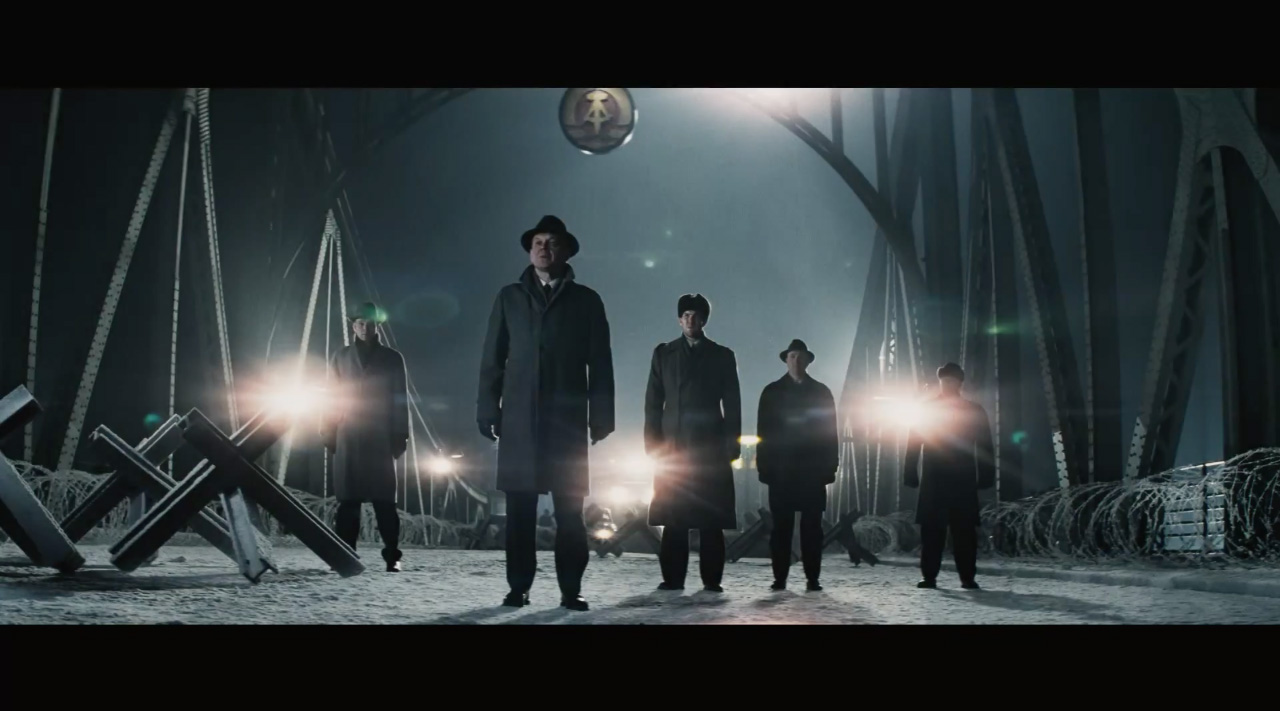


Before I get into why Bridge of Spies really sent chills down my spine I'll have to get into a little personal backstory. I've had a lot of ups and downs with my faith over the past eighteen months or so, going from Christian to "I want nothing to do with the church" to "okay, sure, God exists, but wtf do I do with that information?" So it's not set in stone, exactly; I'm still figuring out where I stand, religion-wise, but I do believe in God and I do love Jesus and I do pray and sing and worship, so for all intents and purposes, let's say I'm a Christian. I was raised Episcopalian and still lean that way, but I have major issues with the representatives of my religion in general, which is kind of problematic to say the least.
So basically, to put it as simply as possible:
1. I believe in the Father, Son, and Holy Spirit
2. I believe in Heaven and angels
3. I believe God is watching us, He loves us, and He wants to save everyone (yes, even the atheists)
4. I believe that love conquers all and that God is love (even when He seems to be mad at us)
5. I believe that there is hope for the world even now when we can't seem to stop shooting each other
...do I sound like a Christian hippie? You know, the kind that makes Adam 4D throw up in his mouth? Yeah, probably. But you get the general point.
Now, there are a lot of religious/spiritual movies out there that claim to "spread the Word" by lacing as many sappy, otherwise-bland romantic comedies and family flicks with Bible references as possible. I've seen a few of these and honestly, they made me throw up a little. Christmas Angel. What If... God's Not Dead. The Christmas Lodge. War Room. All of them so absolutely stupid and insipid that I was either bored to tears or amused at how pathetic the evangelism attempts actually were. All of them so heavy-handed that were I an atheist, I would watch these things and go "ok, let's change the channel, this is stupid." I once got into a minor argument with someone who will not be named, over whether or not The Polar Express was "preachy." I wish I could sit him down in front of Christmas Angel or War Room--I got your "preachy" right here, buddy.
So no, I'm not a fan of "Christian" media. I'm also definitely not a "Christian" filmmaker. Not like that, anyway. I doubt anything I do will be distributed by Pure Flix. (In fact, I beg you, please beat me with a stick if I ever make anything that Pure Flix is interested in. I would literally rather be Tommy Wiseau than get to that point. Seriously.) No, when I find God in the movies, I find Him in less-blatant, less-evangelistic places.
Like, say, in Bridge of Spies.
The plot doesn't sound too spiritual, really, when you look at it on paper. A Soviet spy is caught, tried, and sentenced to prison in America, while a young American spy pilot is shot down and detained in Russia and an American student is captured in East Berlin. The no-nonsense lawyer who defended the Soviet spy is selected to arrange a prisoner exchange, he goes to Berlin to negotiate, and long story short, history is made. A nice little espionage thriller. A period piece--just what Spielberg does best--served with a nice, fresh side of Disneyfied patriotism, interspersed with a lot of talk about the Lord, the Constitution, and How Great America Really Is And Don't You Dare Say Otherwise.
But oh, it's so much more than that. Early on in the film Abel, the Russian spy, tells Donovan, his lawyer, how he once witnessed a man getting beaten by soldiers. The man kept getting back up, no matter how hard the men hit him, so they eventually gave up and let him go. This man served as a role model for Abel, who remains utterly calm even in the face of the death sentence. Whenever Donovan asks him if he is worried or afraid, Abel replies "Would it help?" He refuses to cooperate and pass information to the CIA, even if it would secure his freedom. He is calm and collected no matter what the situation. He is absolutely ready to die or be hurt for his country. "I'm not afraid to die," he tells Donovan when told about the possibility of the electric chair, "even if it's not my preference." Halfway into the first act I realized, shit, I kind of want to be like this guy and he's supposed to be "the enemy." Donovan repeatedly mentions throughout the film what a "good soldier" Abel has been and constantly expresses admiration for his conduct, despite the fact that he and Abel are on opposite sides of a very tense fight.
There is a popular worship song that literally everyone who has ever been to an evangelical protestant church has heard, called "Mighty to Save." In the second verse is the line, I give my life to follow everything I believe in/Now I surrender. I couldn't help but think about that line when I saw the way Abel reacts to his capture, and the way American spy Gary Powers reacts to his capture: both men are absolutely willing to give their lives for what they wholeheartedly believe in. They will surrender to the consequences, knowing they made the right call according to their own hearts and minds. Donovan worries that Abel's associates won't believe that he didn't give up any information to the Americans, and Abel assures him that even if they don't, it will be all right because Abel himself knows that he did not betray his country. That is a damn powerful message, considering our culture's obsession with heroism. In most movies if you do the right thing and aren't rewarded with a ticker-tape parade, it's seen as a tragedy. Here, it's acknowledged that even the right actions are not always noticed and rewarded--and that's okay.
In the Bible, Jesus tells us that our reward will be greater in Heaven if we don't loudly pray on street corners, if we don't make a show of doing the "right" thing or the "holy" thing, if we don't insist on showing everyone how religious we are. His message lines right up with the one presented to us in Bridge of Spies: if you do the right thing and you know it, it doesn't matter who else knows. You know. You are able to sleep at night, knowing you did what you needed to do. And that's all the reward you need.
I felt closer to God watching Bridge of Spies than I ever have watching a blatantly "Christian" movie. And when I look at some of the other movies I love, movies that I feel a spiritual connection to in some form or other, I think I see a pattern. The movies I fall in love with don't preach or force an agenda or insist that what they're showing you is the be-all end-all. They're just there, and let you draw what inspiration, comfort, or message you can from them.
One of my former Christian fellowship friends once saw a film I'd made in high school and commented, "I'd never know you were Christian from your work." Funny thing is, one of my fellow students had teased me about the same movie, saying "your virginity pledge is showing" because the romantic leads didn't have sex in the film. It's all in the way you look at things. Someone else is going to watch What If... and, with a sigh, say as the credits roll, "What a beautiful representation of Christ and His love, I wish everyone could see that movie!" Someone else is going to watch Bridge of Spies and think, "Blah, useless romanticized patriotism." Doesn't make any difference to me, or to Spielberg for that matter.
Because he knows what meaning he put into that film. And I know what meaning I took out of it.
And at the end of the day...you guessed it...that's what really matters.
Monday, November 16, 2015
Dear Movie Theaters
I am angry at you.
Not all of you. But most of you. Collectively, I am angry at movie theaters. And honestly, I really think I have good reason to be.
In this age of instant streaming, video-on-demand, Dish Network, Redbox and YouTube, I do not have to go to a theater to see a movie. I do not have to pay you upwards of $20 to see one movie in one night. I do not have to drive for half an hour or more for the privilege of forcing a pair of 3D glasses over my regular glasses and missing half the movie due to closing my eyes to combat headaches brought on by eye-popping graphics. I have an HD flatscreen TV with access to Netflix, Hulu, Amazon Prime, and YouTube, and I also own a Blu-Ray player. So, in short, screw you. I do not have to pay for the honor of seeing a film that you deem worthy to grace your silver screens. I can wait six months and see it on Netflix, where I get to watch all the movies I want for less than $20 a month. That's right, for $20 per one month, I can see unlimited movies, instead of paying $20 in one night to see one film that I probably had to go way out of my way to see.
What I pay for, in case you care even a single iota, is the experience. And in the last five years or so, holy mother of God has that experience been lacking.
So yes, movie theaters, I am angry, and I am sad. Because in the years since I graduated high school, you have been slowly, gradually stripping away everything I loved about seeing films in a theater.
You have taken away midnight premiere showings, instead beginning showings of a hot new movie at 7:00 the day before. Little hint, guys: just say it comes out on the 19th instead of the 20th. Stop kidding yourselves. Stop lying to us.
You have taken away my choice to wear a costume to a franchise premiere.
You have taken away my ability to feel safe in a movie theater by implementing your ridiculous "security measures" that make me feel more like I'm going through an airport than going to a movie.
You have even taken away my ability to see the movies I really want to see. You see, when you relegate films like Freeheld and Room to tiny arthouse theaters instead of granting them even short runs in your precious mainstream multiplexes, you force those of us who want to see them to drive ungodly distances just to see one film, thus adding gas to the ever-growing cost of seeing a film. Do we really need two dozen showings per day of the latest Paranormal Activity film? I guess so, because you refuse to even give one of those screenings to a real movie.
Back in 2011 I saw the midnight premiere of Harry Potter and the Deathly Hallows II at my local theater. Local, as in, less than ten minutes from my house. I wore my Hermione Granger costume, complete with homemade wand and time-turner, and stood in line for almost an hour and a half to guarantee that I'd get in to see the film--and good thing, too, because by the time midnight rolled around, the entire theater was sold out. Inside the building it was beautiful chaos. The entire place was decorated with Harry Potter paraphernalia, including Warner Bros licensed, life-sized cardboard cut-outs of the characters. Theater staff wore cloaks and wizard hats over their uniforms. Some of them directed us to the screening rooms with wands. Over half the attendees were in costume. There was a palpable energy inside the theater when we took our seats. Some of us were in tears before the film even started. Others couldn't stop shaking with excitement. And when the movie started, forget it. We were all wizards in that moment. We were all Harry, all Hermione, all Ron, all Luna Lovegood and Neville Longbottom and Ginny Weasley. We cheered when Neville pulled the sword out of the hat. We roared our approval at "NOT MY DAUGHTER, YOU BITCH." We cried together over Fred, Tonks, Lupin and Snape's fates. We whistled and "aww"-ed at Harry and Ginny's last kiss. And when it was over, we gave a standing ovation. Some of us who'd brought wands pointed them in the air and said, "Mischief Managed." Perfect strangers hugged and cried on one another's shoulders. It was...there's no other word for it...magical.
That was the last time I saw a movie like that.
Six months ago I saw The Avengers: Age of Ultron at 11:00PM on April 30. Now, let me begin by saying I could have easily seen it at, oh, 6:30 or so had I chosen to do so. I didn't, however, because I wanted to see it with my boyfriend, who didn't get off work until 10:00 that night. We put together a little group: me, him, and I think four of his friends. And that was...it.
No, really. There were exactly eight people in that theater. At the freaking AMC. For Age of Ultron. In that whole room, there were eight of us, I was one of them, and I knew five of the others.
It gets worse. Since I knew costumes would likely get us booted out of the theater, I didn't even bring up the idea of dressing like the Avengers (since there would be six of us, obviously) for the premiere. I dressed in my favorite Avenger's trademark colors, but that was as far as I dared to go. I think one of the guys wore a Captain America t-shirt. That was it. That was as much as we could do. I have no doubt that if I'd showed up dressed like Black Widow I would have been turned away.
It still gets worse. The theater was practically dead. The reactions were mild, to say the least. I heard a smattering of snarky comments from Ian's peanut-gallery friends. I heard some laughs from the couple in the back. I did my share of laughing and rolling my eyes and clutching Ian's hand, but even I couldn't get into the "spirit" of things. How could I? There was no crowd, no mob mentality to roll with. Even the moment when Scarlet Witch finally gave in and joined the Avengers, even when Quicksilver bit the dust, even when Banner and Black Widow kissed for the first time, there were no screams of approval or cries of pain. It was just...there. Like any other movie we could've chosen to see that night.
I told Ian I needed the bathroom after the movie was over. It wasn't really a lie, because I did need the privacy of a bathroom. Safely hidden from his wisecracking friends, I locked myself in a stall and cried. I had so badly wanted the experience that I'd had when I saw Harry Potter that anything less was a crushing disappointment. But I didn't want the others, who seemed more than content just to see the movie in 3D, to know how hurt I was. So I pulled myself together after a few minutes and went back out, pretending that I was as impressed by the graphics and annoyed by the plot holes as they were.
Movie theaters, you have, in plain English, screwed up. You have taken what was once a thrilling experience and made it about as common as grocery shopping. "What are we gonna do tonight?" "I don't know man, let's go see a movie." "Ok bro, whatever."
For one of my senior projects in my last year of college I made a short documentary about the ever-changing movie distribution industry. I asked a theater owner what he thought would "save" movie theaters from the same fate as video stores and he talked about the incomparable experience of seeing a feature film in a theater. So far, so good. But instead of talking about experiences like the one I had seeing Harry Potter, he briefly mentioned something about escapism before going off on a long explanation of how movie theaters have to be more than a theater now. They have to include bars, restaurants, bowling alleys, arcades, party rooms. They can't just, y'know, show movies, don't 'cha know. They have to be more.
But...hold on...what if they don't?
I don't want to go bowling when I see a movie. I don't want to eat overpriced food before or after the movie as well as during the film. (If I'm paying $10 for a bucket of popcorn, you'd better put some freaking fairy dust on that shit.) I don't want to kill 20 minutes after the film playing a first-person shooter game. I don't want to get drunk on cocktails. And I certainly don't want to pay $50 when all is said and done, just to see one movie and have one meal. I don't want to have to drive 35 miles to see Room or Spotlight. I don't want to have to watch a 3-D trailer for Paranormal Activity. I don't want to walk through a metal detector or have my bag searched. I don't need any of that, and I certainly don't enjoy it.
I just want the energy back.
I just want to wear a real Hawkeye costume, instead of resorting to a black t-shirt and maroon jeggings.
I just want to see a midnight premiere at midnight instead of having to see it at 8:00 or 9:00 on a Thursday night with a brain-dead audience.
I just want to see a movie in a packed house with a crowd that's as thrilled to be there as I am.
I just want to go into a theater and, for one or two short hours, forget that people like the Aurora theater shooter exist.
I just want to feel like I used to feel when I walked into a theater: safe, and wanted, and happy. Like I belonged there. Like I was meant to be there.
I just want to go home.
Not all of you. But most of you. Collectively, I am angry at movie theaters. And honestly, I really think I have good reason to be.
In this age of instant streaming, video-on-demand, Dish Network, Redbox and YouTube, I do not have to go to a theater to see a movie. I do not have to pay you upwards of $20 to see one movie in one night. I do not have to drive for half an hour or more for the privilege of forcing a pair of 3D glasses over my regular glasses and missing half the movie due to closing my eyes to combat headaches brought on by eye-popping graphics. I have an HD flatscreen TV with access to Netflix, Hulu, Amazon Prime, and YouTube, and I also own a Blu-Ray player. So, in short, screw you. I do not have to pay for the honor of seeing a film that you deem worthy to grace your silver screens. I can wait six months and see it on Netflix, where I get to watch all the movies I want for less than $20 a month. That's right, for $20 per one month, I can see unlimited movies, instead of paying $20 in one night to see one film that I probably had to go way out of my way to see.
What I pay for, in case you care even a single iota, is the experience. And in the last five years or so, holy mother of God has that experience been lacking.
So yes, movie theaters, I am angry, and I am sad. Because in the years since I graduated high school, you have been slowly, gradually stripping away everything I loved about seeing films in a theater.
You have taken away midnight premiere showings, instead beginning showings of a hot new movie at 7:00 the day before. Little hint, guys: just say it comes out on the 19th instead of the 20th. Stop kidding yourselves. Stop lying to us.
You have taken away my choice to wear a costume to a franchise premiere.
You have taken away my ability to feel safe in a movie theater by implementing your ridiculous "security measures" that make me feel more like I'm going through an airport than going to a movie.
You have even taken away my ability to see the movies I really want to see. You see, when you relegate films like Freeheld and Room to tiny arthouse theaters instead of granting them even short runs in your precious mainstream multiplexes, you force those of us who want to see them to drive ungodly distances just to see one film, thus adding gas to the ever-growing cost of seeing a film. Do we really need two dozen showings per day of the latest Paranormal Activity film? I guess so, because you refuse to even give one of those screenings to a real movie.
Back in 2011 I saw the midnight premiere of Harry Potter and the Deathly Hallows II at my local theater. Local, as in, less than ten minutes from my house. I wore my Hermione Granger costume, complete with homemade wand and time-turner, and stood in line for almost an hour and a half to guarantee that I'd get in to see the film--and good thing, too, because by the time midnight rolled around, the entire theater was sold out. Inside the building it was beautiful chaos. The entire place was decorated with Harry Potter paraphernalia, including Warner Bros licensed, life-sized cardboard cut-outs of the characters. Theater staff wore cloaks and wizard hats over their uniforms. Some of them directed us to the screening rooms with wands. Over half the attendees were in costume. There was a palpable energy inside the theater when we took our seats. Some of us were in tears before the film even started. Others couldn't stop shaking with excitement. And when the movie started, forget it. We were all wizards in that moment. We were all Harry, all Hermione, all Ron, all Luna Lovegood and Neville Longbottom and Ginny Weasley. We cheered when Neville pulled the sword out of the hat. We roared our approval at "NOT MY DAUGHTER, YOU BITCH." We cried together over Fred, Tonks, Lupin and Snape's fates. We whistled and "aww"-ed at Harry and Ginny's last kiss. And when it was over, we gave a standing ovation. Some of us who'd brought wands pointed them in the air and said, "Mischief Managed." Perfect strangers hugged and cried on one another's shoulders. It was...there's no other word for it...magical.
That was the last time I saw a movie like that.
Six months ago I saw The Avengers: Age of Ultron at 11:00PM on April 30. Now, let me begin by saying I could have easily seen it at, oh, 6:30 or so had I chosen to do so. I didn't, however, because I wanted to see it with my boyfriend, who didn't get off work until 10:00 that night. We put together a little group: me, him, and I think four of his friends. And that was...it.
No, really. There were exactly eight people in that theater. At the freaking AMC. For Age of Ultron. In that whole room, there were eight of us, I was one of them, and I knew five of the others.
It gets worse. Since I knew costumes would likely get us booted out of the theater, I didn't even bring up the idea of dressing like the Avengers (since there would be six of us, obviously) for the premiere. I dressed in my favorite Avenger's trademark colors, but that was as far as I dared to go. I think one of the guys wore a Captain America t-shirt. That was it. That was as much as we could do. I have no doubt that if I'd showed up dressed like Black Widow I would have been turned away.
It still gets worse. The theater was practically dead. The reactions were mild, to say the least. I heard a smattering of snarky comments from Ian's peanut-gallery friends. I heard some laughs from the couple in the back. I did my share of laughing and rolling my eyes and clutching Ian's hand, but even I couldn't get into the "spirit" of things. How could I? There was no crowd, no mob mentality to roll with. Even the moment when Scarlet Witch finally gave in and joined the Avengers, even when Quicksilver bit the dust, even when Banner and Black Widow kissed for the first time, there were no screams of approval or cries of pain. It was just...there. Like any other movie we could've chosen to see that night.
I told Ian I needed the bathroom after the movie was over. It wasn't really a lie, because I did need the privacy of a bathroom. Safely hidden from his wisecracking friends, I locked myself in a stall and cried. I had so badly wanted the experience that I'd had when I saw Harry Potter that anything less was a crushing disappointment. But I didn't want the others, who seemed more than content just to see the movie in 3D, to know how hurt I was. So I pulled myself together after a few minutes and went back out, pretending that I was as impressed by the graphics and annoyed by the plot holes as they were.
Movie theaters, you have, in plain English, screwed up. You have taken what was once a thrilling experience and made it about as common as grocery shopping. "What are we gonna do tonight?" "I don't know man, let's go see a movie." "Ok bro, whatever."
For one of my senior projects in my last year of college I made a short documentary about the ever-changing movie distribution industry. I asked a theater owner what he thought would "save" movie theaters from the same fate as video stores and he talked about the incomparable experience of seeing a feature film in a theater. So far, so good. But instead of talking about experiences like the one I had seeing Harry Potter, he briefly mentioned something about escapism before going off on a long explanation of how movie theaters have to be more than a theater now. They have to include bars, restaurants, bowling alleys, arcades, party rooms. They can't just, y'know, show movies, don't 'cha know. They have to be more.
But...hold on...what if they don't?
I don't want to go bowling when I see a movie. I don't want to eat overpriced food before or after the movie as well as during the film. (If I'm paying $10 for a bucket of popcorn, you'd better put some freaking fairy dust on that shit.) I don't want to kill 20 minutes after the film playing a first-person shooter game. I don't want to get drunk on cocktails. And I certainly don't want to pay $50 when all is said and done, just to see one movie and have one meal. I don't want to have to drive 35 miles to see Room or Spotlight. I don't want to have to watch a 3-D trailer for Paranormal Activity. I don't want to walk through a metal detector or have my bag searched. I don't need any of that, and I certainly don't enjoy it.
I just want the energy back.
I just want to wear a real Hawkeye costume, instead of resorting to a black t-shirt and maroon jeggings.
I just want to see a midnight premiere at midnight instead of having to see it at 8:00 or 9:00 on a Thursday night with a brain-dead audience.
I just want to see a movie in a packed house with a crowd that's as thrilled to be there as I am.
I just want to go into a theater and, for one or two short hours, forget that people like the Aurora theater shooter exist.
I just want to feel like I used to feel when I walked into a theater: safe, and wanted, and happy. Like I belonged there. Like I was meant to be there.
I just want to go home.
Friday, October 23, 2015
If you like music and movies...
Composer Jim Steinman loves to refer to his best-known work, Meat Loaf's Bat out of Hell, as a "cinematic" album. And he's right. There's a reason that the 1960s, 70s, and 80s are often credited with some of the best music of the century: because that's freaking true. The Beatles' The White Album, the Who's Quadrophenia, Bruce Springsteen's Born to Run, the Clash's Sandinista!, and of course Bat out of Hell - these are not only some of the greatest albums of all time, but they're also known as concept albums, meaning that unlike 90% of the popular albums released today, they're built around a unifying theme or, in the case of Quadrophenia, the whole album is meant to tell a single story. And I mean, call me a nerd, but holy cow wouldn't that be great for a movie.
3. Bat out of Hell (Meat Loaf)
There's been a movie (or TV special) or two about the making of this album, but I don't want to do a biopic or documentary. I want to do the story of Bat out of Hell. I want to take the stories that Jim Steinman told in his lyrics, and bring them to life. I mean LOOK AT THE COVER ART for heaven's sake and tell me that's not one of the most cinematic things you've ever seen. Imagine that on a movie theater screen. Of course it would be violent--with a title track about a motorcycle crash, how could it not be?--but the more "fun" songs, like "All Revved Up" and "Paradise by the Dashboard Light" would usher in the chance to show off Steinman's infamous sense of humor, and that would be the major hook for an audience.
In the end, I know the odds of actually making any of these films are so impossibly low that it's almost laughable. But that's part of the fun of filmmaking: having an idea that's so out there it'll never happen...and knowing that someday, somehow, if you try, you just might have a chance.
No, really, hear me out. We've made movies out of books, comics, TV shows and amusement park rides (Pirates of the Caribbean, anyone?), and as of lately, a new trend has popped up: making films out of video games. Which is great, don't get me wrong, but you know what's happened a couple of times but never really became a thing, the way making movies out of video games became a thing? Making movies out of concept albums. Oh, sure, it's been done. But it usually was borne out of a desire to create a franchise (think the Monkees TV show or, like, pretty much every single Beatles film ever made). I can only think of a few albums that were ever genuinely turned into a film for the sake of turning an album into a film. And some of them, like Quadrophenia, weren't even direct adaptations, more like dramas loosely based on the original music.
So these are the albums I'd most like to turn into a film if I could. Some of them are Greats. Some of them are...well, not. But they're all close to my heart and if I ever got the chance to make any of them into a movie, you bet I'd take it.
Avery's Top 5 Rock Music Films:
I saw this show performed last year at the Palace of Auburn Hills and...holy shit. I love artists like TSO because it's almost like they set themselves up for this kind of thing. Their albums are mostly rock operas, and The Christmas Attic is no exception. The album tells the story of a little girl who goes up into the attic and finds a box of letters that tell a love story with a sad ending. Now, this might sound entirely cliche, but if you've seen their live show, you know it's anything but. And if I were to make this album into a movie, I'd try to channel that same intensity (though given that it's a movie, maybe I'd dispense with the laser show) and I'd try to include as many members of TSO in cameo roles (or, heck, if they're up for it, major parts) as possible.
Rock Spectacle is the first live performance album from the Barenaked Ladies and it contains some of their finest songs: "When I Fall," "Straw Hat and Old Dirty Hank," "Brian Wilson," and of course the famous "If I Had $1,000,000." This was one of the defining albums of my childhood. When I was a kid my dad would put this on and we'd dance to it - sometimes there'd even be stretches where I made him play it every night. I always felt like there was a story to the music, even when I was little and could understand literally none of the lyrics. Well, now I'm older and (theoretically) wiser, and I feel it now more than ever. This is also probably the album with the most room for fun, because I swear if I made this into a movie, it would have the biggest ensemble cast ever - and, as an added bonus, this band loves to sneak little bits of humor into their music, even some of their less-upbeat songs, which leaves plenty of room for comedic interpretation.
3. Bat out of Hell (Meat Loaf)
There's been a movie (or TV special) or two about the making of this album, but I don't want to do a biopic or documentary. I want to do the story of Bat out of Hell. I want to take the stories that Jim Steinman told in his lyrics, and bring them to life. I mean LOOK AT THE COVER ART for heaven's sake and tell me that's not one of the most cinematic things you've ever seen. Imagine that on a movie theater screen. Of course it would be violent--with a title track about a motorcycle crash, how could it not be?--but the more "fun" songs, like "All Revved Up" and "Paradise by the Dashboard Light" would usher in the chance to show off Steinman's infamous sense of humor, and that would be the major hook for an audience.
It's not exactly a concept album in the vein of Bat out of Hell or Quadrophenia, but you can't deny there's a cohesive sound in Don't You Fake It. It's one of the most underrated albums of all time, and undoubtedly RJA's best. And if you listen to the lyrics, the songs really are mini-stories of their own. Watch Ronnie Winter's Half of Us interview and the inspiration for those stories becomes painfully clear. And that would be the storyline for the movie: the story of the formation of Red Jumpsuit Apparatus, with the real-life events behind each individual song getting a spotlight. And it probably wouldn't be as fun as some of the others (let's be honest though, none of the ones I've thrown out there so far would be straight comedy, except maybe the Rock Spectacle movie), given that it's based in real life as opposed to, say the theatricality of Bat out of Hell, but it's because it's so heavily based in reality that I feel like it's a story that really, really needs to be told.
WHY HAS NO ONE DONE THIS YET!?!? Springsteen once said that he could see every song on Born to Run taking place at the same time, over the course of the same summer night in different places. There's your film plot, right there. And of course "Jungleland," the operatic epic about the Magic Rat and his involvement in an unfortunate street war on Flamingo Lane (my God, Springsteen should've been a novelist), would be the entire third act. The whole thing would, of course, take place in 1970s New Jersey, a shout-out to Springsteen's hometown. The film practically writes itself. If only Clarence Clemons could be here to see it...
In the end, I know the odds of actually making any of these films are so impossibly low that it's almost laughable. But that's part of the fun of filmmaking: having an idea that's so out there it'll never happen...and knowing that someday, somehow, if you try, you just might have a chance.
Wednesday, September 23, 2015
Theory: Your Scathing Condemnation of Fan Theories is Mean
I love fan theories, or headcanons, as some like to call them. I love them. I really do. I love the silly ones. I love the sad ones. I love the ones that could be true. I love the ones that are so insane they're perfect. I love them all.
Apparently, IndieWIRE critic Sam Adams does not agree with me.
Okay, I can see how fan theories might annoy some people. They're pervasive. They're divisive. They start fandom wars. They confuse the living hell out of non-fandom members when they come up in a random Google search. I get it, you don't like it, you wish people would just chill out or keep it to themselves.
Well, I have bad news for you, sir. That's not going to happen. Fan theories, whether you like it or not, are here to stay. I'm not going to even try to explain all the ins and outs of fandom culture. I'd need an entire blog for that. But I will tell you a story. Just bear with me for a minute here and I promise I'll explain myself.
My boyfriend is a huge dork. Not, like, smartest-kid-in-the-school, pocket-protector-wearing, makes-a-nuclear-reactor-out-of-paper-towel-rolls kind of dork, but, like, a pop culture addict kind of dork. And what a lucky girl am I, because guess what? Me too. We're total nerds together. It's kind of amazing. So, we went to Comic-Con together in May. He went to meet Roddy Piper. I went to meet Robbie Thompson. And I went in costume as Castiel, because to me, that was just the height of cool: going and meeting the TV writer who writes episodes based around your favorite character, dressed as that character? Once-in-a-lifetime experience, right there.
Now, in the weeks leading up to the con, we showed each other the movies/TV shows/wrestling matches starring our favorite people, just so we could understand why each of us wanted to meet those celebrities. He showed me Piper's best matches. I showed him my favorite episodes of Supernatural. But before I did, months before, when I was first planning my costume, I tried to explain to him the nature of Dean and Castiel and their relationship. "Well, Dean's a human, and Cas is an angel..." I began, about to do my usual lead-up of now this is just speculation it's not been confirmed yet but it's a very widely accepted fan theory...and then I realized, wait, Ian has never seen Supernatural. He doesn't know who Dean and Castiel are. He has no idea. I don't have to apologize for my views on this. I can just flat-out tell him.
"About half the fandom takes Dean and Cas's relationship at face-value, and believe they're just very good friends. But the other half - and I'm in this sector - interpret their relationship as romantic," I told him matter-of-factly. "We pick up on clues that the showrunners may or may not have intended to leave. It's not confirmed by the show yet whether their relationship is canon or not. It's just a very, very popular, intensely-believed fan interpretation."
"Oh, I see," was Ian's reply. And then we moved on to discuss costumes. I only brought it up because I wanted to warn him not to wear anything remotely Dean Winchester-like at the con, unless he was up for some serious teasing. When I showed him an episode of Supernatural, I made sure to choose one wherein Castiel interacted with both Dean and Meg, just to show him both sides of the debate. And that was that.
But when I hung out post-Comic-Con with him and his friends, one of them was very vocal about his opinion that the Dean/Castiel romance "is a load of bullshit." At one point I made a comment about how I preferred more subtle hints of their romance, because it let the fans truly interpret it for themselves, and I disliked more heavy-handed or obnoxious references and lines like "You know, the angel in the dirty trenchcoat who's in love with you." Before I'd even finished this sentence, the guy jumped in to insist "that's because they're trying to make fun of the idea that this relationship could EVER be romantic." "So basically, they're making fun of people like me," I translated. The guy shrugged it off. "Yeah, pretty much." And then the subject was dropped.
I hate incidents like that. Ian and his friend, without even meaning to, pretty much demonstrated the absolute best way to respond to a fan theory, and the absolute worst way to respond to a fan theory. The best way, even if you think the fan theory is ridiculous, is to just go with it. Let that fan, be it a super-fan or a casual fan, ramble about their interpretation of the story, and then let it go. If you agree with it, great. If not - let it go.
But when his friend insisted that the showrunners of Supernatural actively go out of their way to make fun of the fans who believe in the Destiel theory, it was more than just annoying. It hurt. I wanted to ask, "And what harm, exactly, is this fan theory doing to you? Like are you really so afraid that it might actually be true, that you can't even entertain the thought for five seconds?" It wasn't that he disagreed with me. He was entitled to his opinion. But the way he reacted with eye-rolling contempt, as if believing in the Destiel theory immediately demoted me to "mindless fangirl" status? That really stung.
People who forcibly oppose fan theories remind me of politicians. They really do. They will never be convinced that the fan who came up with the theory has a leg to stand on. They will not only go out of their way to let the whole world know that the theory is WRONG, but they will also go out of their way to discredit the fan who came up with the theory. I've seen comments on those Pixar movie posts ranging from "meh, nice, but it's too out there to be true" (reasonable enough) to "oh my god you are insane get a life you dumbass" (not so reasonable). I don't mind being disagreed with. And I'm sure no one else who supports a fan theory minds, either. What we do mind is being told that we are "crazy" or "stupid" or "fake fans" for coming up with the idea in the first place.
And that was the problem I had with Adams' indieWIRE piece. Is the guy entitled to his opinion? Sure. Fan theories aren't canon. They don't have to be accepted as fact - and they shouldn't be. It's a matter of interpretation. But guess what? You don't have to believe in a fan theory to respect the fan who came up with it. And slamming someone else's interpretation, or personally attacking someone for coming up with a theory you don't agree with, is mean. The fastest way to kill someone's passion for something is to make fun of them. Snorting, rolling your eyes, and calling someone a "fake fan" (or, to use Adams' phrasing, a "so-called fan") because they dared to interpret something differently than you did is a douche move. It's a surefire way to make sure that person never speaks up again. And I know, because I've been there.
So, to all the people who agreed with Adams' take on fan theories: shut up. We get it. You are allowed to think that it's ludicrous to believe that every Pixar movie takes place in the same universe. You are not, however, allowed to say that someone is not a "real fan" because they do believe that.
And to all the people who come up with these fan theories: keep it up. But I beg you, don't waste your breath trying to convince the haters that it's true. They'll just blow you off. But don't let that stop you from putting yourself out there in the first place, because you know what? I met a Supernatural writer. I told him, "I believe in Destiel." I told him that while I was standing there, in front of him, dressed like Castiel. And you know what he said?
He told me, "You go right ahead. If that's how you see the show, you go right ahead and believe that. We put the show out there, that's our job. How you interpret it, that's up to you."
How you interpret it, that's up to you. Words to live by.
Apparently, IndieWIRE critic Sam Adams does not agree with me.
Okay, I can see how fan theories might annoy some people. They're pervasive. They're divisive. They start fandom wars. They confuse the living hell out of non-fandom members when they come up in a random Google search. I get it, you don't like it, you wish people would just chill out or keep it to themselves.
Well, I have bad news for you, sir. That's not going to happen. Fan theories, whether you like it or not, are here to stay. I'm not going to even try to explain all the ins and outs of fandom culture. I'd need an entire blog for that. But I will tell you a story. Just bear with me for a minute here and I promise I'll explain myself.
My boyfriend is a huge dork. Not, like, smartest-kid-in-the-school, pocket-protector-wearing, makes-a-nuclear-reactor-out-of-paper-towel-rolls kind of dork, but, like, a pop culture addict kind of dork. And what a lucky girl am I, because guess what? Me too. We're total nerds together. It's kind of amazing. So, we went to Comic-Con together in May. He went to meet Roddy Piper. I went to meet Robbie Thompson. And I went in costume as Castiel, because to me, that was just the height of cool: going and meeting the TV writer who writes episodes based around your favorite character, dressed as that character? Once-in-a-lifetime experience, right there.
Now, in the weeks leading up to the con, we showed each other the movies/TV shows/wrestling matches starring our favorite people, just so we could understand why each of us wanted to meet those celebrities. He showed me Piper's best matches. I showed him my favorite episodes of Supernatural. But before I did, months before, when I was first planning my costume, I tried to explain to him the nature of Dean and Castiel and their relationship. "Well, Dean's a human, and Cas is an angel..." I began, about to do my usual lead-up of now this is just speculation it's not been confirmed yet but it's a very widely accepted fan theory...and then I realized, wait, Ian has never seen Supernatural. He doesn't know who Dean and Castiel are. He has no idea. I don't have to apologize for my views on this. I can just flat-out tell him.
"About half the fandom takes Dean and Cas's relationship at face-value, and believe they're just very good friends. But the other half - and I'm in this sector - interpret their relationship as romantic," I told him matter-of-factly. "We pick up on clues that the showrunners may or may not have intended to leave. It's not confirmed by the show yet whether their relationship is canon or not. It's just a very, very popular, intensely-believed fan interpretation."
"Oh, I see," was Ian's reply. And then we moved on to discuss costumes. I only brought it up because I wanted to warn him not to wear anything remotely Dean Winchester-like at the con, unless he was up for some serious teasing. When I showed him an episode of Supernatural, I made sure to choose one wherein Castiel interacted with both Dean and Meg, just to show him both sides of the debate. And that was that.
But when I hung out post-Comic-Con with him and his friends, one of them was very vocal about his opinion that the Dean/Castiel romance "is a load of bullshit." At one point I made a comment about how I preferred more subtle hints of their romance, because it let the fans truly interpret it for themselves, and I disliked more heavy-handed or obnoxious references and lines like "You know, the angel in the dirty trenchcoat who's in love with you." Before I'd even finished this sentence, the guy jumped in to insist "that's because they're trying to make fun of the idea that this relationship could EVER be romantic." "So basically, they're making fun of people like me," I translated. The guy shrugged it off. "Yeah, pretty much." And then the subject was dropped.
I hate incidents like that. Ian and his friend, without even meaning to, pretty much demonstrated the absolute best way to respond to a fan theory, and the absolute worst way to respond to a fan theory. The best way, even if you think the fan theory is ridiculous, is to just go with it. Let that fan, be it a super-fan or a casual fan, ramble about their interpretation of the story, and then let it go. If you agree with it, great. If not - let it go.
But when his friend insisted that the showrunners of Supernatural actively go out of their way to make fun of the fans who believe in the Destiel theory, it was more than just annoying. It hurt. I wanted to ask, "And what harm, exactly, is this fan theory doing to you? Like are you really so afraid that it might actually be true, that you can't even entertain the thought for five seconds?" It wasn't that he disagreed with me. He was entitled to his opinion. But the way he reacted with eye-rolling contempt, as if believing in the Destiel theory immediately demoted me to "mindless fangirl" status? That really stung.
People who forcibly oppose fan theories remind me of politicians. They really do. They will never be convinced that the fan who came up with the theory has a leg to stand on. They will not only go out of their way to let the whole world know that the theory is WRONG, but they will also go out of their way to discredit the fan who came up with the theory. I've seen comments on those Pixar movie posts ranging from "meh, nice, but it's too out there to be true" (reasonable enough) to "oh my god you are insane get a life you dumbass" (not so reasonable). I don't mind being disagreed with. And I'm sure no one else who supports a fan theory minds, either. What we do mind is being told that we are "crazy" or "stupid" or "fake fans" for coming up with the idea in the first place.
And that was the problem I had with Adams' indieWIRE piece. Is the guy entitled to his opinion? Sure. Fan theories aren't canon. They don't have to be accepted as fact - and they shouldn't be. It's a matter of interpretation. But guess what? You don't have to believe in a fan theory to respect the fan who came up with it. And slamming someone else's interpretation, or personally attacking someone for coming up with a theory you don't agree with, is mean. The fastest way to kill someone's passion for something is to make fun of them. Snorting, rolling your eyes, and calling someone a "fake fan" (or, to use Adams' phrasing, a "so-called fan") because they dared to interpret something differently than you did is a douche move. It's a surefire way to make sure that person never speaks up again. And I know, because I've been there.
So, to all the people who agreed with Adams' take on fan theories: shut up. We get it. You are allowed to think that it's ludicrous to believe that every Pixar movie takes place in the same universe. You are not, however, allowed to say that someone is not a "real fan" because they do believe that.
And to all the people who come up with these fan theories: keep it up. But I beg you, don't waste your breath trying to convince the haters that it's true. They'll just blow you off. But don't let that stop you from putting yourself out there in the first place, because you know what? I met a Supernatural writer. I told him, "I believe in Destiel." I told him that while I was standing there, in front of him, dressed like Castiel. And you know what he said?
He told me, "You go right ahead. If that's how you see the show, you go right ahead and believe that. We put the show out there, that's our job. How you interpret it, that's up to you."
How you interpret it, that's up to you. Words to live by.
Wednesday, September 16, 2015
The genre judgement conundrum part II: learning to love horror
August 2006. 13-year-old Avery sees a Blockbuster VHS case (my God, those are archaic words, right there) in her dad's hand. "What's that?" she asks.
Dad holds it up so she can see the title. The Rocky Horror Picture Show. "What's that?" she asks again, because up to this point, her only exposure to this cult classic has been the Kidz Bop cover of "Time Warp," which she hasn't listened to in forever because, at this point, she has clearly outgrown Kidz Bop. (But, being the child-at-heart she is, if she still listens to those old CDs time to time...well, who's going to know, really?)
"It's an old musical. From the 1970s." Her mom and dad exchange a look. Is their child old enough to see this? After all, their objective thus far has not been to censor her viewing material (she's been allowed to watch Big Trouble and My Cousin Vinny and The Replacements--movies that most of her friends would have had to see behind their parents' backs) but this is considered widely to be the most raunchy musical of all time. Can they really...?
Finally, assuming (and rightly so) that most of the jokes will go over her head, her mom casually says, "You should watch it with us. It's got Meat Loaf and Tim Curry in it. You'll like it."
And for the first forty-five minutes or so, she does. She giggles at "Dammit, Janet," gets up and dances to the Time Warp, and squeals in delight at her first sighting of Dr. Frank-N-Furter. "That is Tim Curry?" she gasps, not recognizing the man who co-starred in Pirates of the Plain and Home Alone 2--some of her favorite movies of the day. She's a little nervous when Rocky is born, but when she sees not a hideous Frankenstein monster but a muscle-bound jock running around in shiny gold underpants, she starts laughing again. So far, as her parents predicted, she loves it. Sure, a lot of the sexual references are lost on her, and she's a little confused as to why Frank-N-Furter seems to be gay or at least bi (since she knows, from years of watching Eddie Izzard, that "most transvestites actually fancy women"), but those are minor things and overall she's happy.
And then comes Meat Loaf's entrance. And, with it, his gruesome death at Frank-n-Furter's hands. That's when she starts to cry. That's when her parents start to think, oops, might've introduced this one a bit too soon. They let her watch for a bit longer, right up through "Touch-a Touch-a Touch Me," which they hope she will find sufficiently funny to erase the memory of Meat Loaf's untimely demise, but they're careful to shut off the movie before Eddie the Delivery Boy's final...uh...resting place is revealed. Because if she can't handle an ice pick and some blood, they know she won't be able to handle that.
One year from now this movie will be one of her favorites, and she will go to see the play live, dressed as Magenta and singing to every song, squirt gun in hand and a smile on her face. But you couldn't convince her of that now. Not for all the money in the world.
~
So fast-forward now to Halloween 2012. After a lifetime of actively avoiding horror movies, I was facing a conundrum because, you see, my teacher had put The Exorcist on his syllabus, as it's one of the most famous (and, admittedly, one of the most groundbreaking) horror films of all time. Most of my classmates are psyched. It's a great horror film, they insist, and it's just perfect that we're watching it on Halloween night. I'm sure they're right, but I have a problem. I hate horror. I really, truly hate it. There are few times that I've seen a horror film and not hated it: The Blair Witch Project, Let the Right One In, Psycho, and of course Tim Burton's Sleepy Hollow. That's it. The number of horror movies that haven't terrified me into oblivion can actually be counted on one hand.
My mother always said that my problem with movies--and she still says this, now, in 2015, when I'm a college graduate who consistently sleeps with the lights off--was that I had a hard time telling fantasy and reality apart. Maybe that's true. All I know is that up to my college days I could not watch a horror movie without my parents holding my hands. In fact, during a Genres class at Interlochen, we watched Diary of the Dead to study "documented" horror, and I was so shaken I had to leave halfway through the screening and, afterwards, spent the night at a hotel with my parents because I was too afraid to sleep alone in the dorms. I believe by now I have hammered the point home: horror and Avery did not mix. Just couldn't happen.
But on Halloween night, 2012, I caved for the sake of my grade. My teacher was very nice about it, but he would not let me get out of seeing the film. He let me bring my girlfriend and looked the other way when I buried my face in her shoulder during the worst parts, but still I had to sit there, without sneaking out of the room, and watch the movie. And I hated it. Take away the terror factor and I still doubt I'd have liked it; I can see why it's hailed as a masterpiece, but The Exorcist just isn't my taste. But I could handle it. I hated it, but I watched it. The whole thing. Levitation, head-twisting and all.
And I cannot stress how big a deal it is that I stayed for the whole thing. Up to that point I'd even avoided horror films that were part of a class (see: Diary of the Dead incident) and skipped out on Halloween parties because my friends always wanted to watch, well, the Halloween movies and I couldn't do that. I still covered my eyes during certain parts of Lord of the Rings, for crying out loud. I went out of my way to avoid anything scary, much to the frustration of just about any teacher who had me in their class wherein a horror movie was present. This same teacher, the one who gently refused to put up with my B.S. where The Exorcist was concerned, had already had to convince me the previous semester that Planet of the Apes was really worth a second look and that Alien was not, in fact, more terrifying than Paranormal Activity.
So willingly going and not only seeing The Exorcist, but taking notes on it and calmly discussing it in class the following Monday, proved something to me: whether I loved or hated them, I could watch horror movies. I could handle it. I would not collapse into a panic-stricken jelly lump just because a movie had some scary scenes in it. I could do it.
I started pushing my boundaries that very night. I let my girlfriend talk me into seeing Scream - my very first Wes Craven movie - and discovered a simple fact about me and horror films: if it could be defeated, I wasn't afraid of it. A flesh-and-blood killer was something I could deal with. I didn't like gore and I didn't much care for the supernatural (hence my disdain of films like Saw, The Evil Dead, and The Exorcist), but as long as there was a way to defeat the villain I could not only watch a horror film, but find some enjoyment in it. I didn't love Scream, but there were a lot of parts that made me laugh and, unlike Diary of the Dead, I didn't regret going to see it.
More incidents like that one followed. I went to see Warm Bodies, the first - and, to this day, the only - zombie film that I absolutely loved. I started watching Supernatural, a show that I'd avoided for years because I thought it would be too scary, and delighted in watching the villain get defeated in every single episode. Ditto for Buffy the Vampire Slayer. I realized that I'd been scorning horror for years, without realizing that there was so much that I already liked (Tim Burton, Alfred Hitchcock, German expressionist films like Nosferatu and The Cabinet of Dr. Caligari - heck, Roman Polanski's Fearless Vampire Killers had captivated me long before Twilight Fever rocked my high school), and I had been limiting myself out of fear. I resolved not to do that anymore.
When I transferred to Oakland University, my World Cinema teacher showed us Somos Lo Que Hay (translation: We Are What We Are) the same week that I re-watched Let the Right One In for the first time in years. I fell in love with foreign horror - especially of the European variety. I came to the realization that what I really loved, not just tolerated for a grade's sake but loved, was psychological horror. I watched The Sixth Sense and loved it. I watched The Shining all the way through for the first time, and loved it. I watched Silence of the Lambs, I watched all the Hannibal Lecter movies, and I loved them. That fall I saw Peeping Tom in a film theory class and absolutely adored it. My love of psychological horror stemmed from my love of Tim Burton, of Loki the God of Mischief, of the Goblin King and Alex DeLarge and all my other "favorite villains" - the idea that everything isn't what it seems. I realized that without pre-conceived assumptions and fear getting in the way, I could see whatever the hell I wanted to.
I also began to understand my own rules. I needed to have some degree of control over the movie. I needed to be able to pause it and walk away if I had to. I needed to have someone with me, or at least near me, to remind me that it was only a movie. With those few guidelines in place, what couldn't I watch?
I still have moments of doubt, believe me. No power on this earth can make me sit through the Evil Dead or Saw canon. And good luck convincing me to ever, for any reason, sit through an episode of The Walking Dead. I won't go through haunted houses or haunted mazes (acting in one my senior year of high school was more than enough, believe me) and I will never, ever go to an amusement park "fright night" again. I didn't suddenly morph into a horror-lover. I have my limits. If I see a movie that I might like, but looks like it's a scary one, I'll wait for the DVD, thankyouverymuch, and there are plenty of deal-breakers for me. Zombies are a red flag. Cannibalism is pushing it. Possession is a hard limit. And God forbid I ever see anything with the word "exorcism" in the title again.
But this Halloween I will watch Nightmare on Elm Street with Ian. I've always wanted to see it, but dodged it based on the assumption that it would be too scary for me. But it's a fantastic movie, or so I've always heard, and it's one of the defining horror classics, and it's got all the elements I love: a villain with a dark past who attacks his victims on a psychological level, highly stylized aesthetics, and the headship of a kick-ass director. (No one can see Red Eye and not believe Wes Craven was a genius. I'm 100% sure of that.) Maybe I'll have a sleepless night or two over it. But I'm not worried.
After all, I've already handled Pazuzu. After that, how bad can Freddy Kruger really be?
Dad holds it up so she can see the title. The Rocky Horror Picture Show. "What's that?" she asks again, because up to this point, her only exposure to this cult classic has been the Kidz Bop cover of "Time Warp," which she hasn't listened to in forever because, at this point, she has clearly outgrown Kidz Bop. (But, being the child-at-heart she is, if she still listens to those old CDs time to time...well, who's going to know, really?)
"It's an old musical. From the 1970s." Her mom and dad exchange a look. Is their child old enough to see this? After all, their objective thus far has not been to censor her viewing material (she's been allowed to watch Big Trouble and My Cousin Vinny and The Replacements--movies that most of her friends would have had to see behind their parents' backs) but this is considered widely to be the most raunchy musical of all time. Can they really...?
Finally, assuming (and rightly so) that most of the jokes will go over her head, her mom casually says, "You should watch it with us. It's got Meat Loaf and Tim Curry in it. You'll like it."
And for the first forty-five minutes or so, she does. She giggles at "Dammit, Janet," gets up and dances to the Time Warp, and squeals in delight at her first sighting of Dr. Frank-N-Furter. "That is Tim Curry?" she gasps, not recognizing the man who co-starred in Pirates of the Plain and Home Alone 2--some of her favorite movies of the day. She's a little nervous when Rocky is born, but when she sees not a hideous Frankenstein monster but a muscle-bound jock running around in shiny gold underpants, she starts laughing again. So far, as her parents predicted, she loves it. Sure, a lot of the sexual references are lost on her, and she's a little confused as to why Frank-N-Furter seems to be gay or at least bi (since she knows, from years of watching Eddie Izzard, that "most transvestites actually fancy women"), but those are minor things and overall she's happy.
And then comes Meat Loaf's entrance. And, with it, his gruesome death at Frank-n-Furter's hands. That's when she starts to cry. That's when her parents start to think, oops, might've introduced this one a bit too soon. They let her watch for a bit longer, right up through "Touch-a Touch-a Touch Me," which they hope she will find sufficiently funny to erase the memory of Meat Loaf's untimely demise, but they're careful to shut off the movie before Eddie the Delivery Boy's final...uh...resting place is revealed. Because if she can't handle an ice pick and some blood, they know she won't be able to handle that.
One year from now this movie will be one of her favorites, and she will go to see the play live, dressed as Magenta and singing to every song, squirt gun in hand and a smile on her face. But you couldn't convince her of that now. Not for all the money in the world.
~
So fast-forward now to Halloween 2012. After a lifetime of actively avoiding horror movies, I was facing a conundrum because, you see, my teacher had put The Exorcist on his syllabus, as it's one of the most famous (and, admittedly, one of the most groundbreaking) horror films of all time. Most of my classmates are psyched. It's a great horror film, they insist, and it's just perfect that we're watching it on Halloween night. I'm sure they're right, but I have a problem. I hate horror. I really, truly hate it. There are few times that I've seen a horror film and not hated it: The Blair Witch Project, Let the Right One In, Psycho, and of course Tim Burton's Sleepy Hollow. That's it. The number of horror movies that haven't terrified me into oblivion can actually be counted on one hand.
My mother always said that my problem with movies--and she still says this, now, in 2015, when I'm a college graduate who consistently sleeps with the lights off--was that I had a hard time telling fantasy and reality apart. Maybe that's true. All I know is that up to my college days I could not watch a horror movie without my parents holding my hands. In fact, during a Genres class at Interlochen, we watched Diary of the Dead to study "documented" horror, and I was so shaken I had to leave halfway through the screening and, afterwards, spent the night at a hotel with my parents because I was too afraid to sleep alone in the dorms. I believe by now I have hammered the point home: horror and Avery did not mix. Just couldn't happen.
But on Halloween night, 2012, I caved for the sake of my grade. My teacher was very nice about it, but he would not let me get out of seeing the film. He let me bring my girlfriend and looked the other way when I buried my face in her shoulder during the worst parts, but still I had to sit there, without sneaking out of the room, and watch the movie. And I hated it. Take away the terror factor and I still doubt I'd have liked it; I can see why it's hailed as a masterpiece, but The Exorcist just isn't my taste. But I could handle it. I hated it, but I watched it. The whole thing. Levitation, head-twisting and all.
And I cannot stress how big a deal it is that I stayed for the whole thing. Up to that point I'd even avoided horror films that were part of a class (see: Diary of the Dead incident) and skipped out on Halloween parties because my friends always wanted to watch, well, the Halloween movies and I couldn't do that. I still covered my eyes during certain parts of Lord of the Rings, for crying out loud. I went out of my way to avoid anything scary, much to the frustration of just about any teacher who had me in their class wherein a horror movie was present. This same teacher, the one who gently refused to put up with my B.S. where The Exorcist was concerned, had already had to convince me the previous semester that Planet of the Apes was really worth a second look and that Alien was not, in fact, more terrifying than Paranormal Activity.
So willingly going and not only seeing The Exorcist, but taking notes on it and calmly discussing it in class the following Monday, proved something to me: whether I loved or hated them, I could watch horror movies. I could handle it. I would not collapse into a panic-stricken jelly lump just because a movie had some scary scenes in it. I could do it.
I started pushing my boundaries that very night. I let my girlfriend talk me into seeing Scream - my very first Wes Craven movie - and discovered a simple fact about me and horror films: if it could be defeated, I wasn't afraid of it. A flesh-and-blood killer was something I could deal with. I didn't like gore and I didn't much care for the supernatural (hence my disdain of films like Saw, The Evil Dead, and The Exorcist), but as long as there was a way to defeat the villain I could not only watch a horror film, but find some enjoyment in it. I didn't love Scream, but there were a lot of parts that made me laugh and, unlike Diary of the Dead, I didn't regret going to see it.
More incidents like that one followed. I went to see Warm Bodies, the first - and, to this day, the only - zombie film that I absolutely loved. I started watching Supernatural, a show that I'd avoided for years because I thought it would be too scary, and delighted in watching the villain get defeated in every single episode. Ditto for Buffy the Vampire Slayer. I realized that I'd been scorning horror for years, without realizing that there was so much that I already liked (Tim Burton, Alfred Hitchcock, German expressionist films like Nosferatu and The Cabinet of Dr. Caligari - heck, Roman Polanski's Fearless Vampire Killers had captivated me long before Twilight Fever rocked my high school), and I had been limiting myself out of fear. I resolved not to do that anymore.
When I transferred to Oakland University, my World Cinema teacher showed us Somos Lo Que Hay (translation: We Are What We Are) the same week that I re-watched Let the Right One In for the first time in years. I fell in love with foreign horror - especially of the European variety. I came to the realization that what I really loved, not just tolerated for a grade's sake but loved, was psychological horror. I watched The Sixth Sense and loved it. I watched The Shining all the way through for the first time, and loved it. I watched Silence of the Lambs, I watched all the Hannibal Lecter movies, and I loved them. That fall I saw Peeping Tom in a film theory class and absolutely adored it. My love of psychological horror stemmed from my love of Tim Burton, of Loki the God of Mischief, of the Goblin King and Alex DeLarge and all my other "favorite villains" - the idea that everything isn't what it seems. I realized that without pre-conceived assumptions and fear getting in the way, I could see whatever the hell I wanted to.
I also began to understand my own rules. I needed to have some degree of control over the movie. I needed to be able to pause it and walk away if I had to. I needed to have someone with me, or at least near me, to remind me that it was only a movie. With those few guidelines in place, what couldn't I watch?
I still have moments of doubt, believe me. No power on this earth can make me sit through the Evil Dead or Saw canon. And good luck convincing me to ever, for any reason, sit through an episode of The Walking Dead. I won't go through haunted houses or haunted mazes (acting in one my senior year of high school was more than enough, believe me) and I will never, ever go to an amusement park "fright night" again. I didn't suddenly morph into a horror-lover. I have my limits. If I see a movie that I might like, but looks like it's a scary one, I'll wait for the DVD, thankyouverymuch, and there are plenty of deal-breakers for me. Zombies are a red flag. Cannibalism is pushing it. Possession is a hard limit. And God forbid I ever see anything with the word "exorcism" in the title again.
But this Halloween I will watch Nightmare on Elm Street with Ian. I've always wanted to see it, but dodged it based on the assumption that it would be too scary for me. But it's a fantastic movie, or so I've always heard, and it's one of the defining horror classics, and it's got all the elements I love: a villain with a dark past who attacks his victims on a psychological level, highly stylized aesthetics, and the headship of a kick-ass director. (No one can see Red Eye and not believe Wes Craven was a genius. I'm 100% sure of that.) Maybe I'll have a sleepless night or two over it. But I'm not worried.
After all, I've already handled Pazuzu. After that, how bad can Freddy Kruger really be?
Tuesday, September 15, 2015
Hannah Montana, Harry Potter, and the Hollywood habit of blaming everyone but yourself
So, fun fact: before I wanted to be a filmmaker, I wanted to be Hilary Duff when I grew up. Well, not necessarily Hilary Duff. Maybe JoJo, or Ashley Olson, or Selena Gomez or Emma Roberts or, of course, Miley Cyrus. Didn't matter who I patterned myself on, the point is that I wanted to be a Disney Girl. I'd never say as much out loud; I'd phrase it as "I want to be an actress," but I wanted the whole package. I wanted the Tiger Beat photospread, the sold-out pop concerts, the chain store clothing line. I wanted to be Starlet Avery, instead of being the ordinary twelve-year-old girl I really was.
And hey, I could have been, if my parents had thought it was really what I wanted. Had I lived in Burbank, CA instead of middle-of-damn-nowhere Michigan, I could have had a shot at being Hannah Montana. Why not? I was a cute, sassy preteen girl with a giant ham for a dad and mad piano skills. I could dance. I could model, I could pose. I had braces, but sometimes girls need someone who's a little "ordinary" to look up to, isn't that the Disney press-conference line? I could have been, if it had been serious, if it had ever been more than a fantasy.
But thank God I realized that wasn't what I wanted. Acting was fun, but creation was more fun. It was better, I eventually realized, to be Woody Allen than Ashley Olson. Better to be a jack-of-all-trades who could write, shoot, edit, and star in your own movie, rather than someone who said other people's lines both on and off the camera and was literally paid to be cute because, as Mara Wilson so accurately pointed out, when the cuteness goes away, so does your career.
I'm not perfect now, but I'm relatively happy. A few days ago I got into a lecture/argument with my mom, who basically reminded me to shut up, stop complaining that I don't have my dream job (I'm only 22; what the hell did I expect?) and count my f'ing blessings, already. I have a fantastic boyfriend who has gone above and beyond to make me feel loved and supported, and parents who have sacrificed for me and gone to bat for me and cheered me on since the day I was born. I live in a house with a swimming pool in the backyard, my parents let me drive the car pretty much whenever I want, I'm educated and not in debt. I'm working on my next movie, and I'm positive this one will be in more festivals than the last. I'm damn lucky. I'm no popstar, but I'm damn lucky.
Now, does someone want to give Miley Cyrus that talk that my mom gave me? Because I think she needs it.
Look, I clearly can't comment on how it feels to be a child star, because I never was. And I'm not stupid, I know that most people who were raised in the spotlight turn out to be addicts or worse...but wait, is that really true? What about Mara Wilson, Cole Sprouse, Emma Watson, Dakota Fanning, Hilary Duff, or Daniel Radcliffe--people who went to college, got married, had families, found new jobs and new lives apart from show business, or else went on to be successful in their careers despite being the dreaded "child stars?"
We look at entitled dumbasses like Justin Bieber, or lost souls like Lindsay Lohan, and assume that must be where children who are raised in Hollywood end up. It's inevitable. There's no escaping it. It's why Miley Cyrus dirty-danced with a married man at the VMAs. It's why she got naked in her music videos. It's why she smoked salvia and runs around in onesies and curses like a sailor. She's just trying to show that she's grown up, give her some space, dammit; she was a child star, she is to be pitied.
Except I don't feel sorry for her. Not one little bit.
And let me be clear, I have no comment--actually, one sort-of comment, but that's it--on Cyrus' revelations about her gender identity and sexuality. Good for you, Miley. If you're down to date any consenting person regardless of the plumbing God gave them, more power to you. If you identify as androgynous, no problem. Hell, if you come out as trans I wouldn't bat an eyelash; it's your body and your life and you can do whatever you need to do with it.
My problems with Miley Cyrus have nothing to do with where she falls on the LGBT spectrum. I do, however, have a problem with her apparent belief that having any kind of negative experiences in her Disney career somehow gives her a get-out-of-jail free card.
In an interview with Marie Claire, Cyrus claimed that being on Hannah Montana caused her to develop body dysmorphia. Furthermore, she claimed that working 12-hour days gave her anxiety attacks and prevented her from having a normal childhood. Now, all of this may well be true, or it may be exaggerated; I don't know. I do know that the entertainment industry has a long history of high standards and impossible demands when it comes to women's bodies (and, honestly, male bodies too, in most cases) and that teenagers are particularly susceptible to the effects of said impossible standards set by that industry. But...hold up...wouldn't you know that, if you've ever watched, say, one hour of TV in your life? Look at Pretty Little Liars for crying out loud, you've got 28-year-olds playing 16-year-olds; do you really think normal high school girls look or dress like that? Even at age twelve, I knew that being Hollywood-standard pretty came with a price; being unwilling to pay that price was part of what drove me into filmmaking instead of acting.
And to the other point, Miley, you were a twelve-year-old with a six-figure job. Did you think that would be easy? Again, this isn't a case of hindsight. Even when I was ten years old, reading Disney Adventures because I was too young for Popstar, I'd come across articles interviewing the Harry Potter kids (more on them later), all of whom gave full, detailed descriptions of what it was like to be a kid on a movie set. Long hours. Tutoring instead of going to school. Uncomfortable costumes. Demanding directors. Unpleasant shooting conditions. I refuse to believe that if I, at age ten, could read an interview in Disney Adventures and think, huh, this acting stuff isn't really that glamorous, is it, that Miley Cyrus couldn't have come to the same conclusion before landing the role of Hannah Montana.
Furthermore, Cyrus claiming that the show was the sole reason for her body issues or anxiety issues is kind of like me exclusively blaming Interlochen, my former boarding school, for giving me an eating disorder. I was sixteen, living away from home for the first time, and naturally it was a hell of a stressful time. Certainly that stress may have contributed to the situation--but there were so many other factors, and I firmly believe that if I hadn't gone to Interlochen, it would've happened when I went away to college. Or if I'd lived at home for college, I'd have developed that same disorder when I moved out into my first apartment. You get the picture. My circumstances may have exacerbated my issues, but they didn't create those issues. It's not my dorm counselor's fault that I couldn't handle being on my own, nor is it her fault that I didn't ask for help before the problem got out of control.
I'm not saying that Miley Cyrus is a bad person. I am saying that I would have a hell of a lot more respect for her if she would take responsibility for herself and her actions. And as a recent college graduate who is currently working in a fast-food restaurant, allow me to tell you, Miley, that there are much worse jobs you could've had. You could have worked at McDonald's or a super-store like Target, to put yourself through college. You could have lived with your parents until you were 25. You could've been a single mother, or gone to community college because you couldn't afford a 4-year degree, or did what my mom did and wait until you were married with a kid to get your master's degree. My mom has given me a lot to live up to. But I don't mind. And you can bet that if I had gone the Hollywood-starlet route, she wouldn't have let me get away with whining to a magazine that my job just sucked and gave me all kinds of mental issues...but only after it made me a multibillion-dollar household name.
Daniel Radcliffe once said that in the early days of his career, when he was a little kid on the Harry Potter set, he would occasionally whine to his father about how hard his job was. To which his father would reply, "Well, at least you're not down a coal mine." Radcliffe later admitted that fear of failure, and the pressure of fame, led him to drink while on-set of the final Harry Potter film and occasionally turn up hungover for filming, until he recognized his behavior as "unhealthy and damaging" - his words - and went sober in 2010. Notice, however, that while he acknowledges the role that fame played in his troubles, he does not blame his drinking on 12-hour workdays or unwanted beautification; he acknowledges that it was his own fear and insecurity that got him into trouble. And he is quick to credit the Harry Potter franchise for kick-starting his acting career and providing him with experiences that he otherwise never would have had.
I tend to go looking for information on the way the film industry affects people who are so deeply involved in it because, obviously, that is where I want to be. And when my time comes - and I am still optimistic that it will - I don't want to be like Miley Cyrus. I don't want to use my fame to my advantage, and then denounce the very thing that made me successful. I want to be Daniel. I want to be that grounded, and that self-aware. I want to be able to look back at the work that made me who I am, and be proud of it, and think to myself yep, that's it, that was the way to do it.
And hey, I could have been, if my parents had thought it was really what I wanted. Had I lived in Burbank, CA instead of middle-of-damn-nowhere Michigan, I could have had a shot at being Hannah Montana. Why not? I was a cute, sassy preteen girl with a giant ham for a dad and mad piano skills. I could dance. I could model, I could pose. I had braces, but sometimes girls need someone who's a little "ordinary" to look up to, isn't that the Disney press-conference line? I could have been, if it had been serious, if it had ever been more than a fantasy.
But thank God I realized that wasn't what I wanted. Acting was fun, but creation was more fun. It was better, I eventually realized, to be Woody Allen than Ashley Olson. Better to be a jack-of-all-trades who could write, shoot, edit, and star in your own movie, rather than someone who said other people's lines both on and off the camera and was literally paid to be cute because, as Mara Wilson so accurately pointed out, when the cuteness goes away, so does your career.
I'm not perfect now, but I'm relatively happy. A few days ago I got into a lecture/argument with my mom, who basically reminded me to shut up, stop complaining that I don't have my dream job (I'm only 22; what the hell did I expect?) and count my f'ing blessings, already. I have a fantastic boyfriend who has gone above and beyond to make me feel loved and supported, and parents who have sacrificed for me and gone to bat for me and cheered me on since the day I was born. I live in a house with a swimming pool in the backyard, my parents let me drive the car pretty much whenever I want, I'm educated and not in debt. I'm working on my next movie, and I'm positive this one will be in more festivals than the last. I'm damn lucky. I'm no popstar, but I'm damn lucky.
Now, does someone want to give Miley Cyrus that talk that my mom gave me? Because I think she needs it.
Look, I clearly can't comment on how it feels to be a child star, because I never was. And I'm not stupid, I know that most people who were raised in the spotlight turn out to be addicts or worse...but wait, is that really true? What about Mara Wilson, Cole Sprouse, Emma Watson, Dakota Fanning, Hilary Duff, or Daniel Radcliffe--people who went to college, got married, had families, found new jobs and new lives apart from show business, or else went on to be successful in their careers despite being the dreaded "child stars?"
We look at entitled dumbasses like Justin Bieber, or lost souls like Lindsay Lohan, and assume that must be where children who are raised in Hollywood end up. It's inevitable. There's no escaping it. It's why Miley Cyrus dirty-danced with a married man at the VMAs. It's why she got naked in her music videos. It's why she smoked salvia and runs around in onesies and curses like a sailor. She's just trying to show that she's grown up, give her some space, dammit; she was a child star, she is to be pitied.
Except I don't feel sorry for her. Not one little bit.
And let me be clear, I have no comment--actually, one sort-of comment, but that's it--on Cyrus' revelations about her gender identity and sexuality. Good for you, Miley. If you're down to date any consenting person regardless of the plumbing God gave them, more power to you. If you identify as androgynous, no problem. Hell, if you come out as trans I wouldn't bat an eyelash; it's your body and your life and you can do whatever you need to do with it.
My problems with Miley Cyrus have nothing to do with where she falls on the LGBT spectrum. I do, however, have a problem with her apparent belief that having any kind of negative experiences in her Disney career somehow gives her a get-out-of-jail free card.
In an interview with Marie Claire, Cyrus claimed that being on Hannah Montana caused her to develop body dysmorphia. Furthermore, she claimed that working 12-hour days gave her anxiety attacks and prevented her from having a normal childhood. Now, all of this may well be true, or it may be exaggerated; I don't know. I do know that the entertainment industry has a long history of high standards and impossible demands when it comes to women's bodies (and, honestly, male bodies too, in most cases) and that teenagers are particularly susceptible to the effects of said impossible standards set by that industry. But...hold up...wouldn't you know that, if you've ever watched, say, one hour of TV in your life? Look at Pretty Little Liars for crying out loud, you've got 28-year-olds playing 16-year-olds; do you really think normal high school girls look or dress like that? Even at age twelve, I knew that being Hollywood-standard pretty came with a price; being unwilling to pay that price was part of what drove me into filmmaking instead of acting.

And to the other point, Miley, you were a twelve-year-old with a six-figure job. Did you think that would be easy? Again, this isn't a case of hindsight. Even when I was ten years old, reading Disney Adventures because I was too young for Popstar, I'd come across articles interviewing the Harry Potter kids (more on them later), all of whom gave full, detailed descriptions of what it was like to be a kid on a movie set. Long hours. Tutoring instead of going to school. Uncomfortable costumes. Demanding directors. Unpleasant shooting conditions. I refuse to believe that if I, at age ten, could read an interview in Disney Adventures and think, huh, this acting stuff isn't really that glamorous, is it, that Miley Cyrus couldn't have come to the same conclusion before landing the role of Hannah Montana.
Furthermore, Cyrus claiming that the show was the sole reason for her body issues or anxiety issues is kind of like me exclusively blaming Interlochen, my former boarding school, for giving me an eating disorder. I was sixteen, living away from home for the first time, and naturally it was a hell of a stressful time. Certainly that stress may have contributed to the situation--but there were so many other factors, and I firmly believe that if I hadn't gone to Interlochen, it would've happened when I went away to college. Or if I'd lived at home for college, I'd have developed that same disorder when I moved out into my first apartment. You get the picture. My circumstances may have exacerbated my issues, but they didn't create those issues. It's not my dorm counselor's fault that I couldn't handle being on my own, nor is it her fault that I didn't ask for help before the problem got out of control.
I'm not saying that Miley Cyrus is a bad person. I am saying that I would have a hell of a lot more respect for her if she would take responsibility for herself and her actions. And as a recent college graduate who is currently working in a fast-food restaurant, allow me to tell you, Miley, that there are much worse jobs you could've had. You could have worked at McDonald's or a super-store like Target, to put yourself through college. You could have lived with your parents until you were 25. You could've been a single mother, or gone to community college because you couldn't afford a 4-year degree, or did what my mom did and wait until you were married with a kid to get your master's degree. My mom has given me a lot to live up to. But I don't mind. And you can bet that if I had gone the Hollywood-starlet route, she wouldn't have let me get away with whining to a magazine that my job just sucked and gave me all kinds of mental issues...but only after it made me a multibillion-dollar household name.
Daniel Radcliffe once said that in the early days of his career, when he was a little kid on the Harry Potter set, he would occasionally whine to his father about how hard his job was. To which his father would reply, "Well, at least you're not down a coal mine." Radcliffe later admitted that fear of failure, and the pressure of fame, led him to drink while on-set of the final Harry Potter film and occasionally turn up hungover for filming, until he recognized his behavior as "unhealthy and damaging" - his words - and went sober in 2010. Notice, however, that while he acknowledges the role that fame played in his troubles, he does not blame his drinking on 12-hour workdays or unwanted beautification; he acknowledges that it was his own fear and insecurity that got him into trouble. And he is quick to credit the Harry Potter franchise for kick-starting his acting career and providing him with experiences that he otherwise never would have had.
I tend to go looking for information on the way the film industry affects people who are so deeply involved in it because, obviously, that is where I want to be. And when my time comes - and I am still optimistic that it will - I don't want to be like Miley Cyrus. I don't want to use my fame to my advantage, and then denounce the very thing that made me successful. I want to be Daniel. I want to be that grounded, and that self-aware. I want to be able to look back at the work that made me who I am, and be proud of it, and think to myself yep, that's it, that was the way to do it.
Monday, August 3, 2015
My work: 'The Auteur at Work,' 'Moving Along,' and 'Professors'
My senior year of college was spent doing more writing, studying and researching than filming. I wasn't too happy with that. But I did manage to make three short films during that time, one of which I submitted for my senior capstone.
First, there was The Auteur at Work. I teamed up with Morgan, my Michigan-based partner-in-crime, to make a mockery of Auteur Theory, which we'd been learning about in our hard-as-hell film theory class, for our final project. Rounding out our team we had Ian (who is a fairly good actor, and don't let him tell you otherwise), Morgan's brother Collin, and her BFF Cody. Morgan, Ian and I nailed down the concept, I wrote us a script, Morgan took the helm as director, and we convinced Cody and Collin to act for us. Let the games begin!
Since most of us had worked together on Morgan's final project for production class, Death Lets it Go, we were pretty well gelled as a team already. The trick was pulling off a short film in less than three weeks, which as I mentioned when talking about Auto-Incorrect is no small task. The script was completed in two drafts. We didn't have time for storyboards or a beat breakdown. Casting came down to "wanna be in it? cool." Ian and I had to round out the cast, since we only had two real actors and the script called for at least four characters. To top it all off, we had technical difficulties as well: the day-of, we had to call in our production teacher to help with an audio issue, intermittent sunlight made setting up a shot nearly impossible, and we had to location scout on the fly. Then, once we had the damn thing shot, Ian had to work through a cold the last week of class to get it edited, and I was left to help choose the music and take care of post-production effects. Sleep? What's that?
But we pulled it off, and The Auteur at Work turned out to be the most fun I'd had on a film set in a long time. Watch it HERE.
I like making narrative films. I love to watch documentaries, but I don't consider making them to be my strong suit...so how the hell is it that I've ended up making so many of them?!? I've made three for various classes, two for good-cause events at my school, and two just because I felt like it. Huh. That's...a lot, now that I think about it.
Had I stayed at McDaniel, my first college, my senior-year project would have been a narrative. But I transferred to Oakland University, where I had to take a film-exhibition class for my capstone credits, and he wouldn't let me make a narrative film. So I made a documentary on the changing film exhibition industry, with special focus on why Blockbuster went out of business and the ways that theater and other video-store owners are staying in business despite the rise of Netflix and other on-demand services. If that sounds like a lot to pack into a five-minute capstone video, believe me, it was. But the end result was worth it.
The interviews were the easy part...but even the "easy" part involved traveling to Ann Arbor and Bloomfield Hills, coordinating with my mother when and where I could take the car, borrowing equipment from my production teacher, and printing and filing a handful of release forms for all the interviewees to sign. The hard part was finding B-roll and archive footage, as I didn't have any old photos or videos from Blockbuster that I could conveniently slip into the final cut. I ended up taking to the Internet for archive photos, hunting YouTube for old Blockbuster commercials, and asking Ian if I could film inside Disc Replay. And the hardest part of all was editing several hours' worth of material into a five-minute video that told a story without presenting too much of a bias. But all the work paid off when I saw the final cut--and when I saw my grade.
I never pictured myself making a documentary for my last-ever college project--but I'm so glad I did. Check it out HERE.
After all the hard work of my last semester of college, it almost felt like a relief to make another comedy short with Morgan. We were a "production team" for OU's end-of-year showcase, and our task was simple: create content. Make it OU-related. And above all make it good. This is for the school, after all.
Faced with this task, Morgan and I started out making a documentary, which turned into a loosely-scripted mockumentary about our favorite professors. For each of the four teachers we profiled we chose a well-known quirk and blew it way, way out of proportion. Our theory teacher, for example, was known for choosing a wide, often disjointed selection of films for his various classes. We filmed him choosing movies out of a hat and putting them into his class syllabus.
How Well Do You Know Your Professors was probably one of the easiest films I've ever made. The difficult part was finding the time to finish it; at the time that we were making the film, Morgan was writing a 90-page script for her class and I was shooting Moving Along for my capstone assignment. But we were lucky, because our professors cooperated every step of the way. And the reaction we got when we premiered it at the OU end-of-year cinema department showcase? Priceless.
Watch our dorky mockumentary HERE.
First, there was The Auteur at Work. I teamed up with Morgan, my Michigan-based partner-in-crime, to make a mockery of Auteur Theory, which we'd been learning about in our hard-as-hell film theory class, for our final project. Rounding out our team we had Ian (who is a fairly good actor, and don't let him tell you otherwise), Morgan's brother Collin, and her BFF Cody. Morgan, Ian and I nailed down the concept, I wrote us a script, Morgan took the helm as director, and we convinced Cody and Collin to act for us. Let the games begin!
Since most of us had worked together on Morgan's final project for production class, Death Lets it Go, we were pretty well gelled as a team already. The trick was pulling off a short film in less than three weeks, which as I mentioned when talking about Auto-Incorrect is no small task. The script was completed in two drafts. We didn't have time for storyboards or a beat breakdown. Casting came down to "wanna be in it? cool." Ian and I had to round out the cast, since we only had two real actors and the script called for at least four characters. To top it all off, we had technical difficulties as well: the day-of, we had to call in our production teacher to help with an audio issue, intermittent sunlight made setting up a shot nearly impossible, and we had to location scout on the fly. Then, once we had the damn thing shot, Ian had to work through a cold the last week of class to get it edited, and I was left to help choose the music and take care of post-production effects. Sleep? What's that?
But we pulled it off, and The Auteur at Work turned out to be the most fun I'd had on a film set in a long time. Watch it HERE.
I like making narrative films. I love to watch documentaries, but I don't consider making them to be my strong suit...so how the hell is it that I've ended up making so many of them?!? I've made three for various classes, two for good-cause events at my school, and two just because I felt like it. Huh. That's...a lot, now that I think about it.
Had I stayed at McDaniel, my first college, my senior-year project would have been a narrative. But I transferred to Oakland University, where I had to take a film-exhibition class for my capstone credits, and he wouldn't let me make a narrative film. So I made a documentary on the changing film exhibition industry, with special focus on why Blockbuster went out of business and the ways that theater and other video-store owners are staying in business despite the rise of Netflix and other on-demand services. If that sounds like a lot to pack into a five-minute capstone video, believe me, it was. But the end result was worth it.
The interviews were the easy part...but even the "easy" part involved traveling to Ann Arbor and Bloomfield Hills, coordinating with my mother when and where I could take the car, borrowing equipment from my production teacher, and printing and filing a handful of release forms for all the interviewees to sign. The hard part was finding B-roll and archive footage, as I didn't have any old photos or videos from Blockbuster that I could conveniently slip into the final cut. I ended up taking to the Internet for archive photos, hunting YouTube for old Blockbuster commercials, and asking Ian if I could film inside Disc Replay. And the hardest part of all was editing several hours' worth of material into a five-minute video that told a story without presenting too much of a bias. But all the work paid off when I saw the final cut--and when I saw my grade.
I never pictured myself making a documentary for my last-ever college project--but I'm so glad I did. Check it out HERE.
After all the hard work of my last semester of college, it almost felt like a relief to make another comedy short with Morgan. We were a "production team" for OU's end-of-year showcase, and our task was simple: create content. Make it OU-related. And above all make it good. This is for the school, after all.
Faced with this task, Morgan and I started out making a documentary, which turned into a loosely-scripted mockumentary about our favorite professors. For each of the four teachers we profiled we chose a well-known quirk and blew it way, way out of proportion. Our theory teacher, for example, was known for choosing a wide, often disjointed selection of films for his various classes. We filmed him choosing movies out of a hat and putting them into his class syllabus.
How Well Do You Know Your Professors was probably one of the easiest films I've ever made. The difficult part was finding the time to finish it; at the time that we were making the film, Morgan was writing a 90-page script for her class and I was shooting Moving Along for my capstone assignment. But we were lucky, because our professors cooperated every step of the way. And the reaction we got when we premiered it at the OU end-of-year cinema department showcase? Priceless.
Watch our dorky mockumentary HERE.
Subscribe to:
Posts (Atom)